
Moissanite durability: the honest truth about Mohs 9.25 and daily wear
Moissanite is one of the most durable gemstones you can own, ranking 9.25 on the Mohs hardness scale, just below diamond. It will not scratch, cloud, or degrade under everyday wear. If you're worried that your moissanite ring won't hold up during daily life in Aotearoa or across the Tasman, stop worrying. The real durability question isn't about the stone itself. It's about the setting that holds it.
I've made thousands of pieces over the years. The stone is the easy part. What actually fails in a piece of moissanite jewellery is the metal around it. The prongs bend. The band cracks. The backing wears thin. Your moissanite will outlast its setting by decades. That's the durability story you need to know.
At a glance: moissanite durability myths and realities
| What people worry about | What actually happens | The reality |
|---|---|---|
| Moissanite scratches easily | Mohs 9.25 makes it harder than anything you'll encounter in daily life (harder than steel, softer only than diamond) | Scratch-proof for all practical purposes |
| Moissanite chips when you knock it | Hardness and toughness are different. Hardness means scratch resistance; toughness means resistance to chipping. Moissanite is hard but can chip under specific lateral force | Chipping is rare and requires real impact, not a gentle bump |
| Moissanite clouds over years of wear | Lab-grown moissanite does not cloud. Chemical stability is permanent. The clouding myth comes from confusion with cubic zirconia | Will stay crystal clear forever |
| Daily wear ruins moissanite | Moissanite itself is indifferent to daily wear, swimming, hiking, or beach trips | The stone is fine. Check the setting. |
| Moissanite is fragile compared to diamond | Moissanite is nearly as hard as diamond (9.25 vs 10), and both can chip only under a hard directed blow | Virtually identical durability in daily wear, different beauty |
Why moissanite wins for everyday life in Aotearoa
When I choose pieces for Miozuki, I think about New Zealand life first. We wear our moissanite rings through real days here: work, water, weather, bags, hand cream, and all the small contact of ordinary life.
Moissanite handles every bit of that. It doesn't mind salt spray, doesn't fear chlorine, won't degrade under UV light. The stone itself is inert. It has been around for billions of years as a meteorite mineral, silicon carbide, stable and unchanging.
What matters is the metal you pair it with. A gold-plated or gold-filled band will tarnish and wear. Sterling silver will oxidise (that's why I pair my silver pieces with white gold plating for longevity). And prongs, the tiny metal claws that hold your stone, bear the real wear and tear. They loosen. They bend. They need regular care.
That's not a moissanite problem. That's a jewellery problem.
Mohs 9.25: what that number actually means
The Mohs hardness scale runs from 1 to 10. Diamond sits at 10. Moissanite sits at 9.25 on the Mohs scale as the jewellery industry standard figure (mineralogical sources place it as high as 9.5). That one number does almost all the heavy lifting in the durability conversation, and it's worth understanding what it means and what it doesn't.
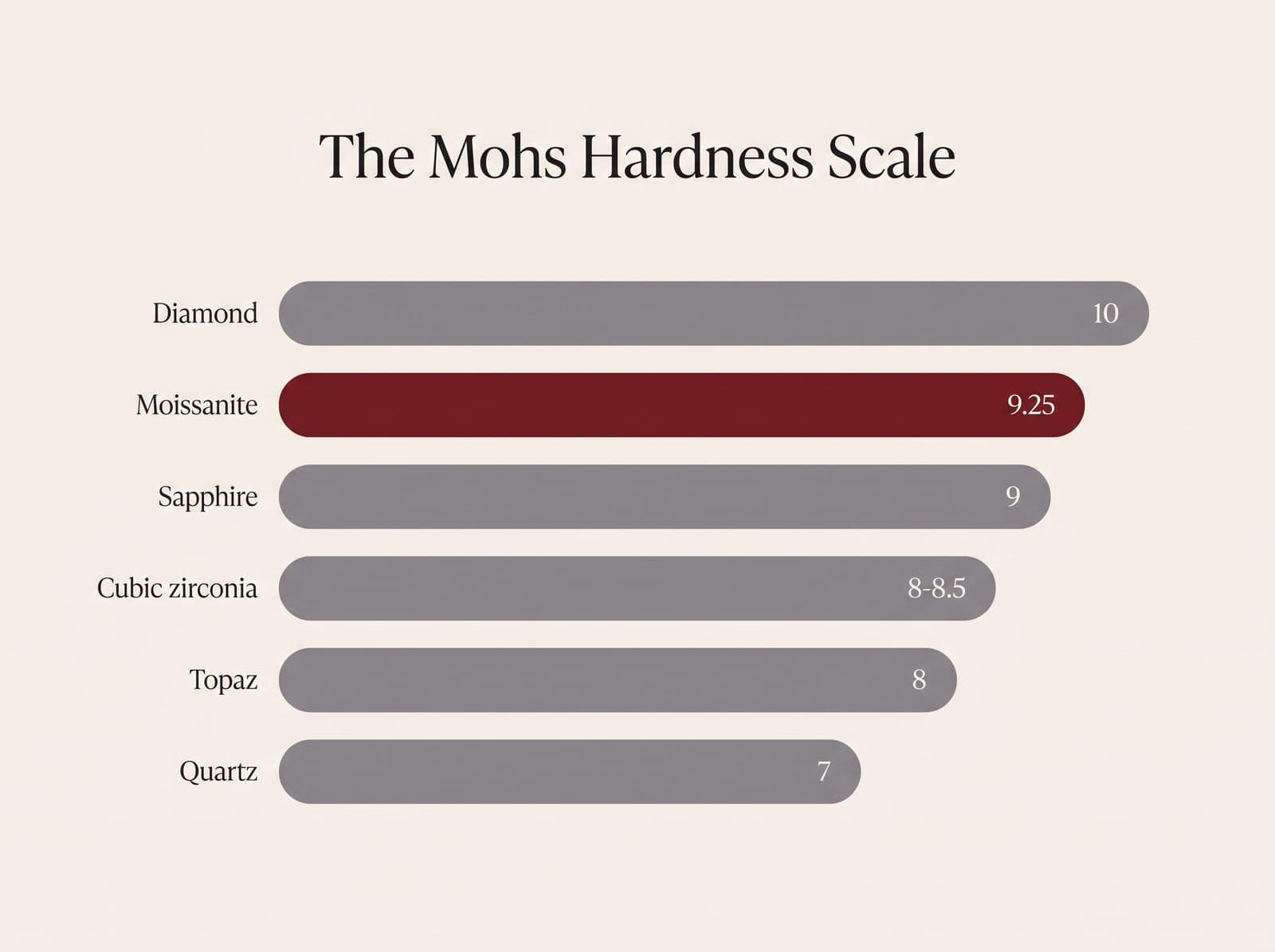
Hardness measures how well a material resists scratching. On the Mohs scale, the intervals aren't equal. Diamond is not just slightly harder than moissanite. It's exponentially harder. The difference between 9 and 10 is vast. But the practical difference in daily life? Negligible.
Here's why. The Mohs scale was built by testing minerals against each other. Moissanite scratches feldspar (which ranks 6) but feldspar scratches apatite (which ranks 5). In your everyday environment, you're not surrounded by high-Mohs minerals. You're surrounded by fingernails (2.5), dirt and sand (6 to 7 on average), metal scrapes (variable), and cloth. Moissanite laughs at all of that.
When people ask me whether moissanite scratches, the answer is yes, but only if you deliberately try to scratch it with something harder. If you drag your moissanite across a diamond or another moissanite, or if you work it against industrial-grade sandpaper, you might see a scratch eventually. In normal life? You won't.
I've seen moissanite rings that have been worn hard for a decade. The stone looks identical to the day it was finished. No scratches. No dullness. The band will have marks, the prongs will have shifted slightly, the gold will have thinned. The stone will be perfect.
The real distinction: hardness versus toughness
This is where the durability conversation gets interesting, and where I need to separate two words that sound similar but mean completely different things in gemology.
Hardness is scratch resistance. Moissanite is hard. Scratch-proof in daily life.
Toughness is resistance to breakage or chipping when struck. This is where the facts matter.
Both moissanite and diamond can chip under a hard, directed blow. Diamond has perfect cleavage in four directions, which means it can split catastrophically along internal planes if struck the wrong way. Moissanite's cleavage is indistinct and it fractures conchoidally (in curved patterns), which means chipping is more likely to happen as small, jagged edges rather than a clean split. Both stones can chip from impact, and neither chips in normal daily wear.
I've never seen a moissanite stone actually break from normal wear in a Miozuki piece. I've seen prongs bend and shift. I've seen bands weaken and need resizing. I've seen the metal backing lose its finish. I've never seen the moissanite itself fail under ordinary wear.
Is it impossible? No. Could you chip a moissanite if you banged it hard enough on a stone floor? Yes. But you could do the same to a diamond. For all practical daily-wear purposes, both stones are equally durable.
The clouding myth: why moissanite will never cloud
This is the question I get asked the most, and I'm glad to answer it because the answer is simply no.
Moissanite does not cloud. Not after five years. Not after fifty years. Not ever.
The myth exists because of a real phenomenon with cubic zirconia, a much cheaper lab-grown stone that can cloud and dull with regular wear. Because cubic zirconia is softer, everyday scratches, oils, cleaning products, and surface buildup can make it look hazy after a few years. That is why cubic zirconia clouds but moissanite does not, and it is also why people sometimes assume the same happens to moissanite. It doesn't.
Moissanite is made of silicon carbide. That's a compound that is chemically and optically stable indefinitely. It was already stable for billions of years as a meteorite mineral before anyone started making it in a lab. A lab-grown moissanite is no different from a natural moissanite found in space, except for the origin. Both are chemically identical and both are permanent.
The clarity you see the day your ring arrives is the clarity you'll have in fifty years, when you pass it on to someone you love.
Setting durability: where moissanite jewellery actually fails
Now we get to the honest part.
Moissanite doesn't fail. Settings do.
A ring made with a moissanite stone in gold or platinum will hold the stone forever if the metal is cared for. But the metal itself is softer, more malleable, and subject to wear. Prongs loosen. Bands develop micro-cracks. Gold plating thins and oxidises. The stone is secure until the metal gives up.
For daily wear, I look for settings with enough metal around the stone, secure prongs, and a band that feels balanced rather than fragile. That means:
Prong design. Thicker prongs are less likely to bend or loosen. Thin, delicate prongs look beautiful but wear faster. I favour prongs that can take a knock.
Gold thickness. A solid gold band is more durable than plated or filled. If you're wearing your piece every day, solid gold lasts longer. Gold-filled (a bonded layer, thicker than plating) is the middle ground.
Backing and underside. The back of a ring is where people don't think to look, but it takes stress. A band that's hollow wears faster than one that's solid. A hollow back of a solitaire setting will eventually weaken.
Metal choice. Platinum is heavier and usually the longest-wearing option, but it also sits at a higher budget. For most Miozuki shoppers, the practical decision is between S925 sterling silver and 9k gold. Sterling silver keeps the ring accessible and beautiful with care. 9k gold is the stronger choice for a moissanite ring worn every day, especially in an engagement-style setting.
The clouding myth gets all the attention. The setting durability question is where real wear happens, and it's worth thinking about when you choose a piece.
For active New Zealand life, I suggest solid metal settings over plated or filled. The difference in cost is real, but the difference in longevity is bigger. A gold-filled or plated ring with a moissanite stone might last five to seven years of daily wear before it needs significant refinishing. A solid gold piece will last a generation or more.
Is 9k gold better than sterling silver for a moissanite ring?
For daily wear, yes, 9k gold is usually the stronger long-term choice. That does not make sterling silver wrong. It means each metal has a different job.
Moissanite itself is not the fragile part of the ring. The stone resists scratching, does not cloud, and will keep its fire. The setting around it takes the real wear: prongs, band, underside, and finish. Sterling silver is beautiful and accessible, but it asks for more care over time, especially if you wear the ring through hand washing, salt air, cleaning products, or heavy use.
9k gold, also written as 9ct gold in New Zealand, gives the ring a more durable metal foundation while keeping the piece more accessible than higher-carat gold or platinum. It is a sensible middle ground for someone who wants a moissanite engagement ring or a meaningful daily-wear ring, not just an occasional piece.
White gold keeps the look cool and classic. Yellow gold brings warmth and a softer vintage feeling. Rose gold gives moissanite's sparkle a gentler, romantic frame. The best choice is the one that suits your hand, your wardrobe, and how hard you wear your jewellery.
For the current metal choices, see Miozuki's moissanite rings in 9k gold and sterling silver, or use the moissanite ring choosing guide if you want help comparing style, setting, and stone shape together.
Moissanite for active NZ and Australian lifestyles
Here's where moissanite genuinely shines for a New Zealand or Australian life.
We swim. The ocean, pools, thermal pools in Rotorua. Moissanite doesn't mind any of it. The stone is inert. Chlorine, salt water, minerals in thermal pools, none of it affects the stone. The metal backing is what you need to monitor. Extreme minerals can speed up the oxidation of some metals. Thermal pools in particular are harsh on standard sterling silver, though white gold plating helps.
We hike and spend time outdoors. Moissanite is robust. Sand, dirt, gravel, dust. None of it will cloud or scratch the stone. Dust might collect under the stone where it meets the metal, and you'll want to clean it out occasionally. But the moissanite itself doesn't degrade.
We travel and move around. Moissanite is lighter than diamond for the same apparent size, which means a two-carat moissanite solitaire is more comfortable to wear all day. That's not a durability advantage, but it's an everyday-life advantage.
We have unpredictable weather. Salt-laden air, UV exposure, temperature swings. Moissanite handles all of it. The metal will tarnish or oxidise depending on what it is, but the stone remains unchanged.
The durability story for Aotearoa or Australia is the same: buy the moissanite without worrying about the stone, and invest in solid metal or well-made plated settings. That's where your durability lies.
Setting durability in detail: the prong and backing story
Let me walk you through the real failure points, because this is where I spend time in design.
When a moissanite stone "fails" in a ring, nine times out of ten, it's because the prong has loosened, bent, or broken. The stone itself is fine. But it's now sitting in a compromised setting, vulnerable to shifting and eventually falling out.
Prongs are typically made of the same metal as the band. That metal is much softer than moissanite. Gold is on the Mohs scale at 2.5 to 3. Platinum is harder, maybe 4 to 4.5. Either way, the prongs will deform under stress long before the moissanite scratches.
I look for settings with thicker prongs and more material where the prongs meet the stone. This increases durability significantly. A thinner prong, even in platinum, will loosen faster than a thicker prong in 14K gold. Weight and metal distribution matter more than the specific metal.
The backing of a setting is equally important. If the back of a solitaire setting is hollowed out too much, the whole structure weakens. Every flex of the band is transmitted to the prongs. Over years, the prongs loosen.
I favour settings with solid backs and a weight distribution that protects the prongs. This adds maybe 20% more metal, maybe 5% more cost, and adds years of durability.
For active wearers, particularly people who hike, swim, or work with their hands, I recommend regular checks. Every two or three years, take your ring to a jeweller and have the prongs checked. A professional can tighten loose prongs before they become a problem. A $50 check-up every few years is cheaper and easier than replacing a setting.
How moissanite stacks up durability-wise
Moissanite and diamond are nearly identical in durability. Diamond is Mohs 10. Moissanite is Mohs 9.25. The difference doesn't matter in practice. Both will scratch only if deliberately scratched with something harder. Both can chip if struck the wrong way, though diamond is more likely to cleave catastrophically. Both are chemically stable forever. Both, when set poorly, will fail in the setting, not the stone.
I've made engagement rings in both. A well-set moissanite will outlast a poorly set diamond. A well-set diamond will outlast a poorly set moissanite. The stone is nearly irrelevant to the longevity equation. The setting is everything. For a full side-by-side comparison of moissanite and diamond across all dimensions, see the moissanite vs diamond guide.
Durability by the numbers: lifespan and care
Here's what I tell people about moissanite in daily wear.
The stone itself: Forever. Permanent clarity, permanent hardness, permanent fire. There's no expiration date.
Solid gold setting: 20 to 40 years of daily wear, possibly more. After that, the metal thins, prongs may need reinforcement, and the band might need remake. This is normal wear, not failure.
Gold-plated or gold-filled setting: 5 to 10 years of daily wear, depending on the thickness of the plate and how hard you wear it. Salt water and harsh conditions accelerate this.
Platinum setting: Longer than gold, often 30 to 50 years, because platinum is denser and resists deformation. Cost is higher. Durability payoff is real.
The prongs: Check every few years, tighten as needed. Replace if bent or cracked. This is routine maintenance, not a failure of the moissanite.
The backing: Solid is more durable than hollow. If your setting has a hollow back, monitor it. A solid back will likely outlast the rest of the band.
This is not specific to moissanite. Every gemstone in every setting follows this timeline.
Caring for your moissanite to maximise durability
Here's my advice for keeping your piece looking and performing like new.
Clean it regularly. Dust and body oils accumulate under the stone and make it look dull. Use silver polishing cloths and never acid or harsh chemical cleaners. A gentle clean once a week keeps the fire sharp.
Avoid extreme conditions. Swimming, hiking, ordinary life: all fine. But if you're doing something genuinely abrasive (rock climbing, heavy manual labour, contact sports), consider removing the ring. Not because moissanite is fragile, but because the metal backing might take damage.
Check the prongs annually. Have a jeweller inspect your ring once a year if you wear it daily. Prongs can loosen gradually, and catching it early prevents disaster.
Resize your ring only once. Every time a ring is resized, the metal is weakened slightly. Resizing is safe, but doing it many times accumulates stress. If your finger size is changing, aim for a permanent fit rather than repeated adjustments.
Store it safely. If you're not wearing it for a while, store it in a soft pouch away from extreme temperatures and humidity. Moissanite doesn't care, but the metal does.
Replate or refinish every five to seven years. If your ring is gold-plated or gold-filled, have the plating refreshed periodically. This is a small cost and keeps the piece looking new.
These are normal jewellery care practices, not moissanite-specific needs.
Second look: moissanite durability in detail
| Durability factor | What you need to know | NZ and AU context |
|---|---|---|
| Hardness (Mohs scale) | 9.25, nearly identical to diamond (10). Resists scratching under any normal circumstance. | Hiking, outdoor work, active life: no risk. |
| Toughness (resistance to chipping) | Can chip under high-impact lateral force; unlike diamond it doesn't cleave along a plane, it chips in small conchoidal patterns. Practical chipping risk in daily wear is low. | Falls onto pavement or concrete could chip an edge, but this is rare. Same risk as diamond. |
| Chemical stability | Permanent. Will not cloud, discolour, or degrade under UV light, salt water, chlorine, or minerals. Chemically identical whether lab-grown or from meteorite. | Salt-water air, thermal pools, beach wear: stone is completely safe. |
| Setting durability | This is where moissanite fails, not the stone. Prongs loosen and bend. Bands thin and weaken. Metal backing can crack. | Solid metal settings last 20-40+ years. Plated settings 5-10 years. Check prongs every 2-3 years. |
| Active-lifestyle wear | Moissanite doesn't mind hiking, swimming, outdoor activities, or salt-water exposure. The metal around it does. | For hikers, swimmers, outdoor workers: prioritise solid metal settings. Gold-filled minimum, solid gold or platinum ideal. |
| Maintenance requirements | Annual professional inspection of prongs. Regular (weekly to monthly) gentle cleaning. Refinishing every 5-7 years if plated. | NZ salt air accelerates tarnishing on unplated silver. Thermal pools can speed oxidation on some metals. Plan accordingly. |
| Longevity expectation | Stone: forever. Setting: 20-50 years depending on metal and care. | A Miozuki piece made with solid gold and a moissanite stone is made for long-term daily wear. |
Your moissanite is built to last
The durability of moissanite is not a question mark. It's a fact. Mohs 9.25 means it will not scratch. Chemical stability means it will not cloud. Practical toughness means chipping is rare and requires real impact.
What I ask you to focus on is not the moissanite, but the metal around it. Choose solid metal over plated when you can. Have the prongs checked every few years. Clean it gently and regularly. And when the time comes to pass it on, the stone will still be perfect.
Common questions
Can moissanite actually chip, or is it unbreakable like people say?
Moissanite can chip, but only under significant lateral impact, not from everyday bumps or normal wear. The difference between hardness and toughness matters here: moissanite is hard (scratch-proof) but not infinitely tough to chipping. I've never seen a moissanite chip in a Miozuki piece from daily wear.
Will my moissanite look cloudy after a few years of wearing it every day?
No. Moissanite does not cloud, now or ever, because it is chemically and optically stable permanently. The clouding myth comes from confusion with cubic zirconia, which is a cheaper stone that does cloud over time due to its unstable crystal structure. Moissanite will have the same clarity in fifty years as it does today.
Is moissanite really safe to wear in the ocean, or should I take it off in salt water?
Moissanite is completely safe in salt water, and the stone itself is inert to salt, chlorine, minerals, and UV light. What you actually need to monitor is the metal setting around it, as sterling silver will oxidise (tarnish) in salt water; white gold plating helps protect it. For regular ocean wear, I recommend solid gold or platinum settings.
Is 9k gold durable enough for a moissanite engagement ring?
Yes. 9k gold is a practical daily-wear option for a moissanite engagement-style ring, especially when the setting is well made and the prongs are checked over time. The stone is already highly durable; the metal choice helps the whole ring wear better.
What's the difference between the moissanite itself failing and the setting failing?
The stone almost never fails in normal wear, but the metal around it does. Prongs loosen and bend, bands thin and crack, and the moissanite itself will stay unchanged while the metal weakens around it. That's why I focus design effort on settings, not the stone. A beautiful stone in a weak setting won't last, but a strong setting holds the stone forever.
How often do I need to get my moissanite ring checked or serviced?
Have your ring professionally inspected every two to three years if you wear it daily; a jeweller can check the prongs, tighten them if needed, and spot any weakening in the band before it becomes a problem. This is preventative maintenance, not a sign that anything is wrong with the moissanite. A small inspection cost is much easier than replacing a whole setting.