
Pearl Earring Size Guide: What the Measurements Look Like On
I recommend 4 or 6 mm pearl studs for a subtle look, 8 mm for a fuller look, or 10 to 12 mm for a bolder look. How much of your earlobe the pearl covers depends on the size of your lobe and where your piercing sits.
How round pearl studs look from 4 to 12 mm
A 4 mm pearl gives you a tiny point of light. At 6 mm, you can see more of its round shape. An 8 mm pearl has a fuller look, while 10–12 mm studs give the pearl a more noticeable presence on the lobe. All five measurements below are the diameter of a round pearl, measured straight across.
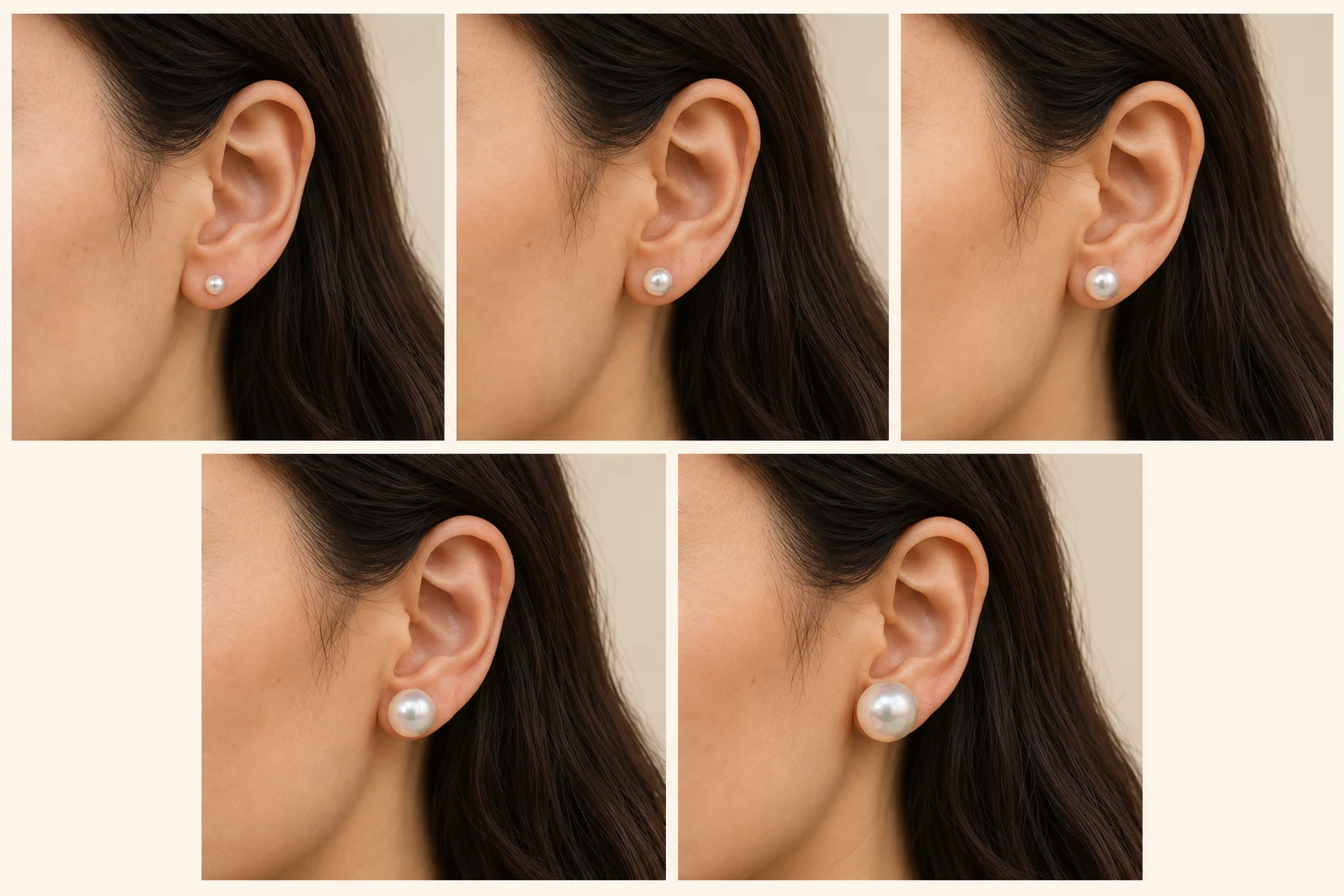
4 mm
6 mm
8 mm
10 mm
12 mm
| Round pearl size | What you might notice when worn |
|---|---|
| 4 mm | A tiny accent with plenty of lobe visible around it. Consider this if you like the look of a small stud or want a little pearl in a second piercing. |
| 6 mm | A small, distinct pearl with an easy-to-see round shape. It can suit you if you like a modest stud that still looks clearly like a pearl. |
| 8 mm | A fuller circle that stands out more than a 6 mm stud. How much of your lobe it covers depends on your piercing position and lobe size. |
| 10 mm | A bolder stud that covers more of the lobe. If the post sits behind the centre, a 10 mm pearl reaches about 5 mm below the piercing. Compare that with the distance to the bottom edge of your lobe. |
| 12 mm | A prominent round stud. It may extend below the edge of your lobe if the lobe is small or the piercing sits low. Look at a photo of the earrings being worn and ask about the backing if you are unsure how they will sit. |
If you are deciding between 6 and 8 mm, the extra 2 mm adds about 1 mm on either side of the centre. Try drawing both circles and holding them by your ear to see which one looks more like you. For a baroque stud, check its height and width separately because the outline can stretch further in one direction.
See how two Miozuki studs sit on the ear
These two pairs from the Miozuki pearl earrings collection show what that means in practice. One pairs a small round pearl with moissanite. The other puts a wider, longer baroque pearl in view.

Moissanite & Pearl Duo Studs

Fresh Water Baroque Pearl Studs
Which measurement are you looking at?
| Measurement | What it tells you |
|---|---|
| Round pearl diameter | How wide the pearl is across its face. A 6 mm round pearl measures about 6 mm across. |
| Baroque pearl height and width | How tall the pearl is and how wide it is at its broadest point in the listed orientation. |
| Overall earring height | How much space the visible design takes up from top to bottom. Ask what the seller includes in that measurement. |
| How far a drop hangs | Where its lowest point sits in relation to the piercing. Ask for the distance from the piercing to the bottom if that is the number you need. |
GIA’s guide to measuring pearls explains why round pearls are described by diameter and other shapes are measured in more than one direction. The extra number helps when you are looking at a baroque pair. A tall, narrow pearl and a tall, wide pearl can look quite different even when they are the same height.
6 mm round pearl
18.5 × 13.5 mm baroque example
What a 6 mm pearl looks like in the Duo Studs
The Moissanite & Pearl Duo Studs pair a 6 mm round freshwater pearl with a 5 mm moissanite. Look closely at the ear image and you can pick out two separate shapes, with the moissanite sitting above the pearl. The moissanite adds visible height above the pearl.
If you already own a plain 6 mm pearl stud, use it as a reference for the pearl itself. For a comparison of the entire Duo earring, look at both stones and their setting together. Ask for the finished height if that measurement matters to you.
How an 18–19 mm baroque pearl looks on the ear
The pearls in the Fresh Water Baroque Pearl Studs are listed at about 18–19 mm high and 13–14 mm wide. In the gallery image, the pearl takes up a broader area around the lobe, and its uneven edges are part of what you notice. The taller number tells you how far the pearl spans from top to bottom. The width helps you picture how much of the lobe it may cover.
Each pearl can vary a little in shape and size. If you are drawn to a particular curve or outline in the photograph, ask whether you can see the pair you are considering. Where it sits on you will also depend on where your piercing is in relation to the edge of your lobe.
How to picture the size on your own ear
- Start with a pair you already wear. Lay one earring next to a millimetre ruler and measure across the part you see when you wear it. That gives you a familiar size to compare against.
- Sketch the shape on paper. Try a 6 mm circle for a round pearl, or sketch a baroque shape inside a rectangle about 19 mm tall and 14 mm wide. Hold the paper beside your ear in a mirror. It gives you a rough idea of the space the pearl takes up.
- Look for the piercing in the photo. A stud with the post near the top of its design may extend further below the piercing than one with the post nearer the middle. A side view can also show how far the earring sits away from the ear.
- Ask for the missing number. For a drop, ask how far it hangs below the piercing. If weight matters to you, ask for the weight of one earring and compare it with a pair you already enjoy wearing.
If two sizes look similar on a screen, try the paper comparison with both. Look in a mirror from the distance you would normally stand, then see which outline you prefer. The paper gives you a sense of coverage. The photos show the shape and setting, and a try-on is where you can judge the feel for yourself.
Choose how much pearl you want to see
For a small touch of pearl, begin with a smaller diameter and check whether other stones or metal add height. If you want the pearl to be the first thing you notice, look at its width as well as its height. A wider baroque stud can give you that look while sitting at the lobe. If you want movement below the ear, check where a drop ends and how it moves when worn.
Once you know what you want to see in the mirror, the pearl earrings buying guide can help you decide between styles. You can also ask Miozuki about a measurement if the listing gives only the pearl size.
Common questions
Is a 6 mm pearl the same size as a 6 mm earring?
A 6 mm round pearl measures 6 mm across. The finished earring can take up more space when a setting, another stone or a hook adds to it.
How do I read baroque pearl measurements?
Compare both height and width. Height shows how far the pearl spans from top to bottom, while width helps you picture how much space it may take up across the lobe.
Why do pearl earrings look bigger in some photos?
Camera distance and cropping can change how large the same earring appears. Use the stated measurements to compare size and look at worn images for where the piece sits in relation to the piercing.
How can I tell how far pearl drop earrings will hang?
Ask for the distance from the piercing to the lowest point of the earring when worn. A measurement for the pearl alone leaves out the hook or setting above it.