
Moissanite Resale Value NZ: The Honest Answer
I'll start with the question you're actually asking, because I'd rather be straight with you than dance around it.
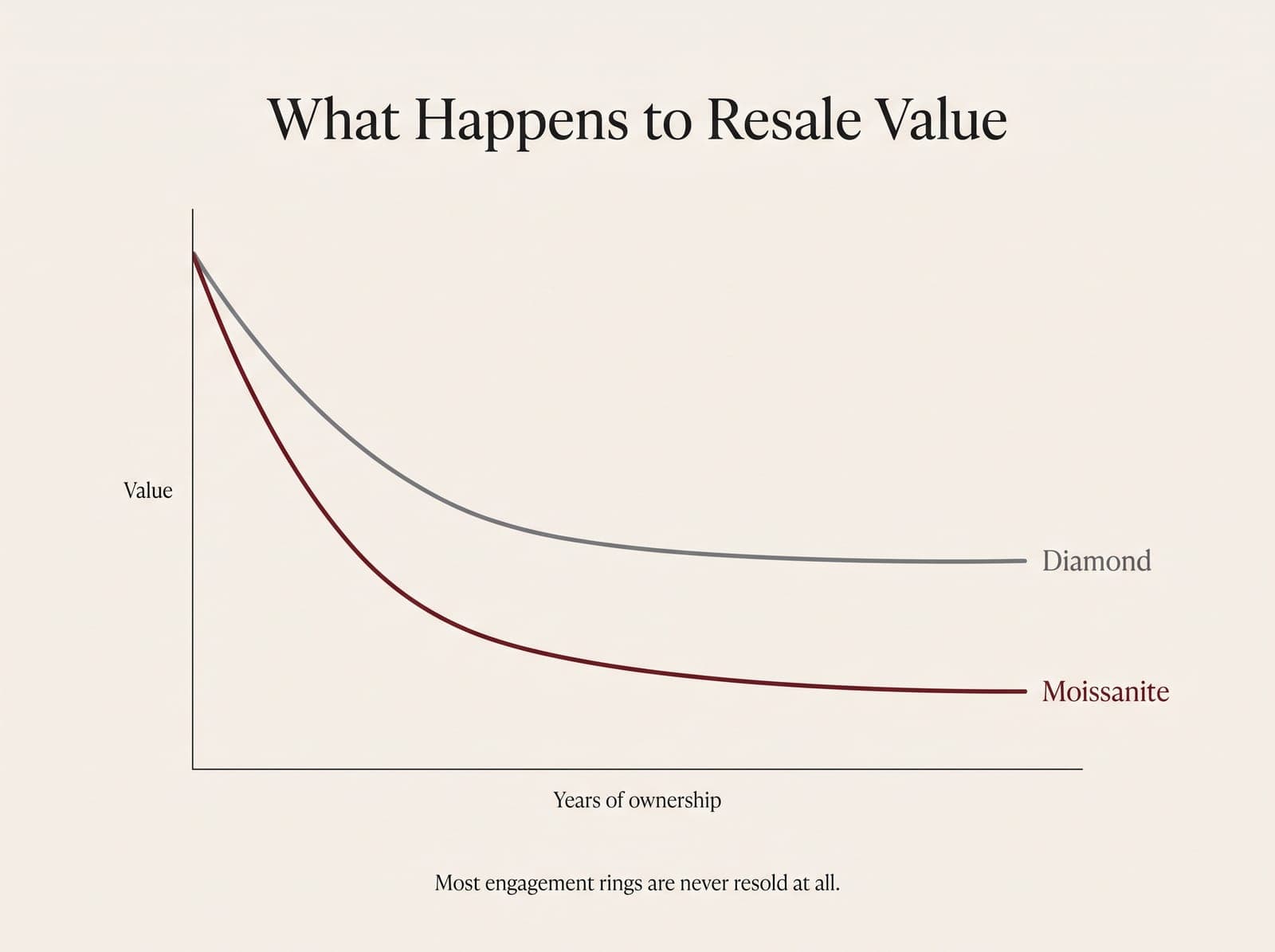
Moissanite has low resale value. Very low. If you buy a moissanite ring for $3,000, you're unlikely to resell it for $1,500 two years later, or even get close. No established secondhand market exists for moissanite the way it does for diamonds. There's no standardised pricing, no easy resale channel, no pawnshop formula, no auction house that specialises in moissanite (DovEggs). This is the core truth, and if that's your main concern, then moissanite probably isn't the right choice for you. But before you walk away, I want to reframe what that actually means for a buyer.
At a glance: what you're looking at
| What you're buying | Resale reality | What actually holds value |
|---|---|---|
| Moissanite stone | Very poor. No standardised secondary market (DovEggs) | Barely any |
| Lab diamond stone | Also poor. 30–40% typical recovery (LaBrilliante), better than moissanite but still steep | Barely any |
| Mined diamond stone | Better than lab, worse than you'd hope. 20–60% best-case recovery (beyond4cs.com) | Some, but not what you pay for |
| The setting (gold/platinum/silver) | Good. 80-95% of spot price, usually | All of it |
| The craftsmanship (design, making) | None. Completely lost on resale | None |
| Wearing it, loving it, passing it down | Priceless. Gets better every year | Everything |
Why moissanite resale value is so low
There are three reasons, and understanding them matters.
No commodity market. Diamonds, even lab-grown ones, have an established secondhand system. Auction houses, pawnbrokers, jewellery stores, and diamond bourses all trade them. Diamonds produced for resale move through pawnbroking, auctions, second-hand jewelry stores, and organized dealer networks. Moissanite has no equivalent. It's not traded by dealers, not listed in auction catalogues, not fluid. If you want to sell, you're trying to find an individual buyer on a platform like Facebook Marketplace or Trademe, competing against new stock at a retailer. That's a weak bargaining position.
Moissanite is lab-grown, so the supply is unlimited. A mined diamond came out of the ground once, cut into a specific stone, and that stone is unique in some small way. The scarcity is real. Moissanite is made in a lab, anywhere in the world, in any quantity. You can order 100 more tomorrow that are optically identical to the one you own. That kills any scarcity premium a reseller might otherwise claim.
Diamonds carry a brand premium even on resale. A De Beers diamond or a Tiffany diamond still pulls more money secondhand because the brand holds cultural weight. Moissanite doesn't have that yet in New Zealand or Australia. It's getting there. But right now, moissanite is still the "alternative", not the preferred choice, which means the cultural narrative around it works against resale price.
Put together, those three things tank moissanite resale value. And honestly, they're not fixable. The supply will only grow. The lack of secondary market infrastructure is a structural problem, not a temporary one. This is the honest version of what you're getting into.
But diamonds aren't much better. Here's what most people don't know.
Everyone assumes that diamonds hold their value. They don't, and that gap between perception and reality is where the real insight lives.
A mined diamond does resell better than moissanite, yes. You might recover 20 to 60 per cent of what you paid for a high-quality diamond, with best-case recovery at the top of that range (beyond4cs.com). That's better than moissanite's lack of a standardised secondary market, but it's still steep. You're looking at losing roughly half your money at best when you sell a quality diamond back. For moissanite, you're looking at losing significantly more.
The reason diamonds hold more value than moissanite is not that they're intrinsically better at retaining worth. It's that an actual secondary market exists for them. Liquidity creates value. Moissanite lacks liquidity, so it lacks that resale value boost.
Now here's the kicker: both of these stones are purchased by people who never intended to resell them. Most engagement rings don't hit the secondhand market. They get kept, passed down, worn until they fall apart, or they sit in a drawer. The resale value of an engagement ring you plan to keep is entirely irrelevant to whether it was the right purchase.
When resale value actually matters
There are a few legitimate reasons you might be thinking about resale value.
You're hedging against a breakup or marriage dissolution. Fair. You want to know you can recover some cash if things don't work out. In that case, you should be thinking about this differently. The question isn't "which stone will I resell for the most." It's "which stone will be easiest to sell quickly if I need to." Diamonds win that race because a dealer will take them, and you'll get cash within a week. Moissanite won't have a dealer channel in most NZ towns, so you're listing it privately and hoping. If speed and certainty matter more than price, diamonds are the hedge.
You're buying an engagement ring on a tight budget. You're stretching for something you can't quite afford. In this case, moissanite's low resale value becomes a real trap. If you overstretched on a moissanite piece because "it's cheaper", you're now holding something you can't easily get out of if your circumstances change. Don't buy moissanite because it's cheap. Buy it because you love it and you're choosing it for itself, not as a placeholder until you can afford a diamond.
You're comparing investment potential. Please don't. Neither diamonds nor moissanite are investments. They're not commodities like gold or platinum. They're consumer goods. Buying either as an "investment" is a bet that someone else will pay more for it later, and that's not how personal jewellery works. Jewellery is bought for meaning, for beauty, for the life you live in it. Treat it that way.
What actually holds value in a piece of jewellery
Here's what does retain worth on resale.
The metal. Gold, platinum, and silver have real commodity value. An 18 karat gold setting will always be worth something close to the spot price of gold, regardless of the stone it holds. When you're buying a ring, roughly 20 to 40 percent of what you pay goes to the setting. That part doesn't evaporate.
The overall quality and design. A beautifully made ring with clean proportions and flawless craftsmanship does better on resale than a poorly made one. Not because the design itself is worth money, but because people perceive it as better made, and they're willing to pay more for the whole piece. This effect is small, but it's real.
The story. A ring you mention has a custom design, or was made by a known designer, or came from a named craftsperson, pulls a small premium on resale because someone buys into that narrative. This is psychological, but it moves the needle.
Everything else: the stone's sparkle, the design's meaning to you, the way it felt when you got engaged, the memories of wearing it. None of this is recoverable as cash. And that's exactly the point.
The reframe: why we make jewellery to be passed down, not sold
This is where the real philosophy comes in, and where moissanite stops being a budget compromise and starts being a genuine choice.
Jewellery made well is made to last. Not because it'll be worth money later, but because it'll be with you, and with the people you pass it to, for decades. A ring worn daily for 30 years, then passed to a daughter or a friend, has more value in lives lived than in dollars on a secondhand market. That's not romantic fluff. That's the actual economics of heirloom thinking.
Moissanite is durable and stays beautiful under daily wear. The value proposition is not "you can sell it later," but "this will be beautiful every time you put it on, and it'll be beautiful when you pass it down." For the full durability story, see our moissanite durability guide.
A diamond holds value on resale partly because it's rare. Moissanite holds value in a different way: it stays gorgeous, stays durable, stays meaningful. A grandmother's moissanite engagement ring passed down to her granddaughter isn't worth less as a heirloom because moissanite doesn't resell. It's still a beautiful ring, worn by two generations, and that's what makes it matter.
This is especially true in New Zealand and Australia, where we don't have the same cultural weight around "having a diamond" that exists in other places. You're not buying moissanite because you can't afford a diamond. You're buying it because you're choosing something real and beautiful and built to last, and you care more about that than about a theoretical resale value you probably won't need anyway.
What type of buyer moissanite actually fits
Moissanite is for someone who is buying a ring because they want to wear it, love it, maybe pass it down. It's for people who care more about what they'll wear every day than about what it might fetch at a pawn shop in 2036. It's for people who see a ring as a daily companion, not an asset.
If you're buying on a tight budget and moissanite is only affordable because it's cheap, reconsider. Save longer or look at a smaller diamond. Moissanite deserves better than to be a placeholder.
If you're buying because you love the way moissanite sparkles, because you want something that'll stay beautiful forever, because you're imagining passing it down to your kids, then moissanite is exactly right. And the fact that it won't resell for much becomes irrelevant. You weren't planning to sell it anyway.
The dual choice for NZ and AU buyers
New Zealand and Australia both have active bridal markets and access to moissanite, so the choice is the same whether you're in Auckland or Melbourne. The resale landscape is similar across both countries: diamonds have a modest advantage in secondary markets, moissanite doesn't. Neither will make you money. Both will last forever if you treat them well. The difference is in which one you want to wake up to every day.
If you're buying from New Zealand, you're paying in NZD, and shipping within the region is straightforward. AU buyers pay in AUD but often import from NZ retailers because the choice and design tend to be stronger here. Either way, the resale-value story doesn't change.
Common questions
Can I sell moissanite to a jeweller?
Most jewellers won't buy moissanite stones directly because there's no established wholesale market for moissanite jewellery. They'll buy the precious metal setting, but not the stone itself. Your best option is to sell privately through platforms like Facebook Marketplace or Trademe.
Will moissanite ever develop a secondhand market?
It's possible, but don't count on it. As moissanite becomes more mainstream, dealer networks might emerge, but the unlimited supply of lab-grown stones makes this unlikely. The lack of scarcity means there's no natural incentive for dealers to build the infrastructure other gemstones have.
If I can't resell moissanite, what if I change my mind about the ring?
You're basically committed to keeping it. If that prospect terrifies you or makes you hesitant, moissanite probably isn't the right choice for you, and that's worth knowing now before you buy.
Is a smaller diamond better than moissanite if I care about resale?
Only if resale is truly your primary concern and you're willing to spend more. A half-carat mined diamond will resell slightly better than a one-carat moissanite, but not dramatically, so it's not a decisive factor for most buyers.
Should I buy moissanite from Miozuki if I'm worried about resale?
Only if you love the ring for itself and not for its resale potential. A Miozuki piece may help slightly because it comes from a named jeweller with a coherent brand story, but that benefit is tiny and doesn't change the core fact of low resale value.
The honest answer to "what's the resale value of moissanite" is: low, and it matters less than you think. The more useful question is "do I love this ring enough to wear it every day for the rest of my life?" If the answer is yes, resale value is a distraction. If you're hesitating, then moissanite probably isn't the right stone for you, and that's okay too. The right choice is the one you'll be happy with every time you look at your hand.