
Moissanite Ring Sizes: How 1–5 Carats Look on the Hand
I find millimetres more helpful than carat labels when picturing a ring on the hand. As a rough guide, round diamonds from 1 to 5 carats span about 6.5 to 11.1 mm in diameter. The table below gives approximate diameters for each size; the photograph gives you a visual reference for how smaller and larger round diamonds look on a hand. For a moissanite ring, check the centre stone's actual measurements too: its shape and what the seller means by “carats” can change the comparison.
Then think about how much you want to notice the ring when you look down at your hand. Would you enjoy a smaller centre, something more eye-catching, or a ring that becomes part of your whole look? As you browse the moissanite ring collection, keep two or three favourites in mind. You do not need to choose the largest stone your budget allows.
Picturing smaller and larger round stones
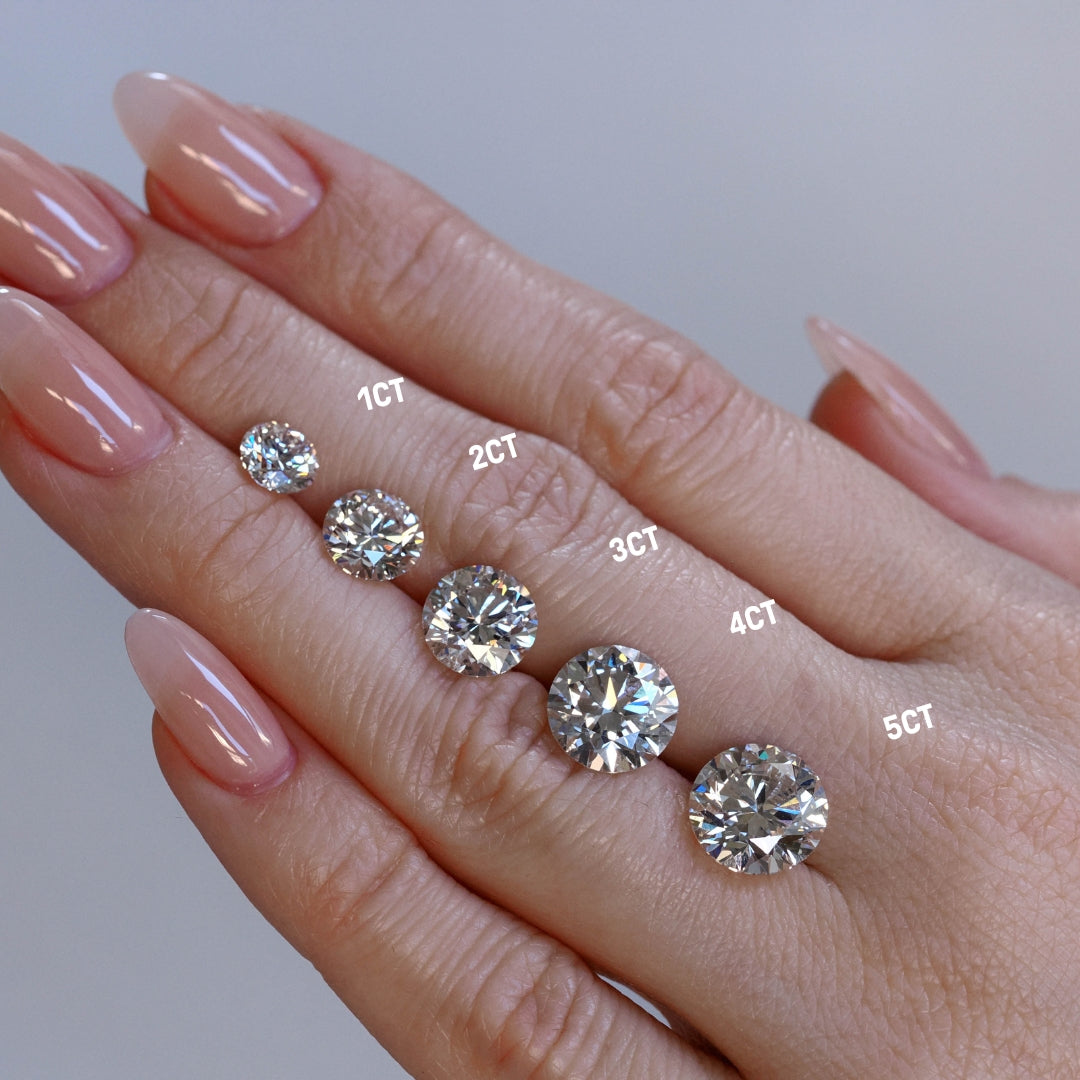
With the same shape, increasing carat weight does not increase the width at the same rate. That is why I find it easier to compare millimetres than to rely on the carat number alone.
What do the carat descriptions mean?
GIA explains that carat measures weight, not size. With moissanite, also check whether the seller means actual gemstone weight, diamond equivalent weight (DEW), or the total weight of stones in the ring. These are different descriptions.
DEW is a comparison with diamond size; it does not mean the moissanite weighs that amount. A total-carats description may include smaller stones, so it should not be treated as the centre stone's weight without checking.
Here are the approximate round-diamond diameters behind that size range. Use them to understand a diamond-equivalent description, then check the measurements of the moissanite you are considering. The figures are sourced reference estimates, not measurements taken from the photograph above.
| Round diamond reference | Approximate diameter | A way to approach the choice |
|---|---|---|
| 1 carat | 6.5 mm | Start here if you prefer a smaller centre. |
| 2 carats | 8.2 mm | Compare this with 1 carat if you want the centre to take up more space. |
| 3 carats | 9.4 mm | Consider this part of the range if you enjoy a more prominent centre. |
| 4 carats | 10.3 mm | Look closely at the overall outline and how much attention you want the ring to draw. |
| 5 carats | 11.1 mm | Start here if a large centre is part of what you love about a ring. |
Approximate diameters are from Diamond & Sapphire's round-diamond reference chart. Cut proportions affect dimensions. For the broader technical explanation, use our moissanite millimetres and DEW guide.
The Miozuki examples below show how the shape, band and setting contribute to the finished look. Their photos are taken at different scales, so compare their listed measurements when judging size.
1 carat: start with a smaller centre
If you want a centre stone that is easy to enjoy without making size the main feature, begin here. Smaller does not mean that a ring has to disappear on your hand. The outline, setting and the contrast with the band all contribute to what you see.
Miozuki's Classic Moissanite Solitaire Ring lists a 6.5 mm round centre. That gives you a specific measurement to compare with the next design you open. Its plain band also lets you focus on the centre without a row of accent stones alongside it.

2 carats: compare the centre, not just the name
If a smaller centre leaves you wanting a little more presence, look at the next size up in the same shape. I would compare those two before jumping straight to the largest option. It is easier to work out what you like when you change one thing at a time.
Be careful with product names here. Our 2 Carat Solitaire Pavé Ring currently lists a 7 mm round centre and a separate total-carats description. That is not the 8.2 mm diamond reference above. Check the centre measurement and ask what the carat label includes rather than assuming the two are equivalent.

3 carats: give the shape some thought
Once you are considering a more prominent centre, compare its length and width as well as its label. An elongated stone can extend further along your finger without taking up as much space across it. You may prefer that longer outline even when you are not looking for more width.
The 3 Carat Oval Pavé Ring lists a 10 × 8.2 mm oval centre. Picture that length alongside its pavé band: both help create a different look from a plain round solitaire.

4 carats: look at the whole ring
At this point, I would take a moment to picture the ring with the clothes and other jewellery you usually wear. If you enjoy a visible centre, that can be part of the pleasure of choosing it. You do not need to make it look understated to justify liking it.
Look at the side view too. A large face-up outline does not tell you the setting height or how the ring will feel. For the 4 Carat Radiant Pavé Ring, ask us to confirm the centre's length and width before making a numerical comparison; those measurements are not currently stated in its published details.

5 carats: choose it because you enjoy the presence
If a large centre is what draws you to a ring, give yourself room to explore it. A smaller finger does not mean you must choose a smaller stone, and a larger hand does not oblige you to choose a larger one. The amount of presence you enjoy is personal.
Our 5 Carat Long Cushion Pavé Ring lists an 11 × 9.2 mm centre. That is a long cushion outline, rather than an 11.1 mm round. Compare the actual shape and dimensions before deciding which look you prefer.
You can explore these styles together in the moissanite ring collection. Look at the whole design as well as the centre that first caught your eye.

The published measurements of these Miozuki examples
For a closer comparison, these are the dimensions listed on the linked product pages, checked on 29 October 2026. The carat labels in the first column come from the product descriptions; they do not necessarily describe centre-stone weight or DEW. These are published specifications, rather than independent measurements of the photographed samples.
| Product description | Listed centre shape | Listed centre dimensions |
|---|---|---|
| Classic Solitaire, 1 carat | Round | 6.5 mm |
| Solitaire Pavé, 2 carats | Round | 7 mm |
| Oval Pavé, 3 carats | Oval | 10 × 8.2 mm |
| Radiant Pavé, 4 carats | Radiant | Not published; confirm before comparing |
| Long Cushion Pavé, 5 carats | Long cushion | 11 × 9.2 mm |
The 2-carat pavé listing needs clarification about its carat label, and the 4-carat radiant needs a confirmed centre measurement. Until then, use the dimensions that are available and avoid treating the five product names as a uniform increase in centre size.
How I would choose the amount of presence
Start with the pair you feel most drawn to. If you keep returning to smaller centres, compare the first two sizes. If you love a larger outline, spend time with the upper end of the range instead. There is no need to work through every size before allowing yourself a favourite.
Then look at a photograph that shows the whole hand, not only a close-up of the ring. Compare like with like where you can: the same finger, a similar hand position, the same camera distance and the same image scale. A tightly cropped photograph can make even a smaller centre fill the screen.
I would also picture the ring beside any band you plan to wear with it. If you need help with the rest of the design, our guide to choosing a moissanite ring brings the shape, setting and metal choices together. For the fit of the band itself, use the NZ/AU ring size converter; finger size and centre-stone size are separate decisions.
Finally, leave yourself a budget you feel happy with. You can use the NZ moissanite ring cost guide for context, then return to the ring you would enjoy looking at and wearing. I would choose that feeling over reaching a particular carat number.
Common questions
Is a 2-carat moissanite twice as wide as a 1-carat?
No. Doubling a weight label does not double the diameter, and moissanite listings may use different meanings for carats. Compare the centre-stone measurements in millimetres and check what each label describes.
Will the same stone look the same on every hand?
No. Finger proportions, the setting and the photograph can change your impression of its size. Use a whole-hand view as well as a close-up, and treat public comparison photographs as references rather than a promise of your own result.
Can I use a diamond size image to choose moissanite?
You can use it as a rough visual reference if the shape and dimensions are relevant. It does not show the moissanite's actual weight, sparkle or the appearance of a particular finished ring. Check the stone's dimensions and the finished ring before choosing.
Does a larger centre always mean a higher setting?
No. Centre size alone does not establish the setting height. Look at the side view and ask for the relevant measurements before choosing.
Which moissanite size should I choose?
Choose the amount of presence you enjoy, then check the actual dimensions and the complete design. Start with two nearby sizes and compare them in a similar view. A larger stone is an option, not a goal you have to reach.