
How to tell real vs fake pearls
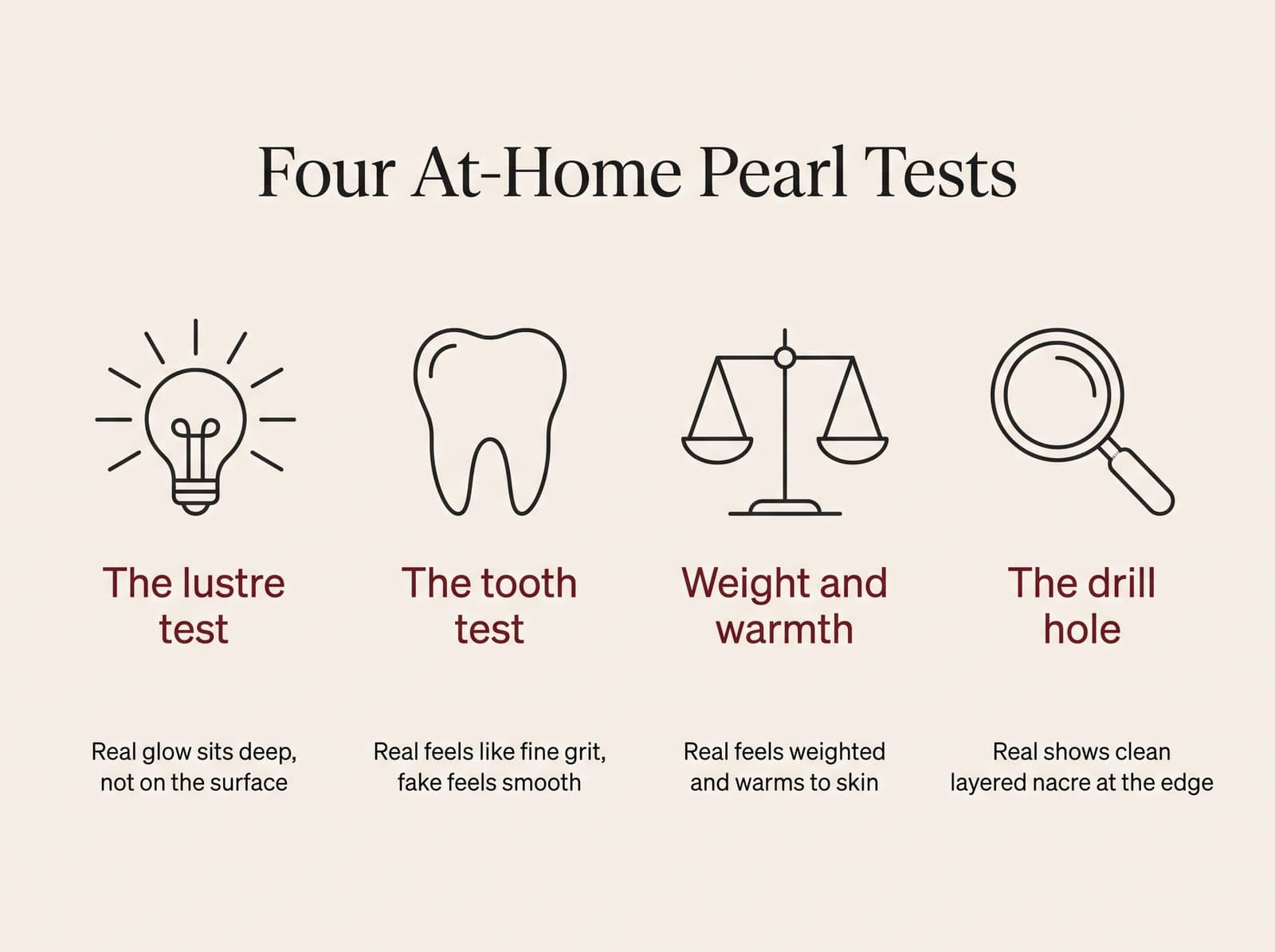
The easiest test? Hold a pearl up to the light and look at how it glows. Real pearls have a soft, coherent glow that sits deep inside the nacre, like light caught under water. Fake pearls shine harshly on the surface, flat and waxy. That's your first answer, the one you can do right now with the pearl in your hand.
But there's more you can check, all simple, all at home. Real pearls are porous. They have character. They feel lived in, not factory perfect. The tests below will help you trust your hands and your eyes.
The at-a-glance pearl test guide
| Test | What you do | Real pearls | Fake pearls |
|---|---|---|---|
| Lustre (glow) | Hold to light, watch how it glows | Soft, coherent glow that sits deep inside | Harsh, waxy shine only on the surface |
| Tooth test | Gently rub the pearl against your front tooth, without pressing | Feels slightly gritty, like fine sandpaper (nacre ridges) | Feels perfectly smooth or slippery |
| Surface texture | Look closely under bright light without magnification | Subtle micro-texture, never uniform | Unrealistically smooth or plastic-looking |
| Drill hole | Peer into the hole where it's strung | Natural layering visible, slight shine variations | Painted edge, overly smooth, uniform colour |
| Weight and temperature | Hold it, feel its heft and warmth | Feels naturally weighted, slowly warms to skin temperature | Feels lightweight or cold, no warmth change |
| Shape and imperfections | Look for variation in shape, tiny marks, colour shifts | Slight asymmetry, natural variation, visible growth marks | Perfect symmetry, no marks, artificial uniformity |
My quick recommendation
To check whether pearls are real, start by looking at their lustre. Genuine pearls usually have a soft, deep glow rather than a shiny, plastic-like finish. You can also hold them in your hand. They should feel slightly heavy for their size and cool to the touch at first. Real pearls are rarely perfectly uniform, so small differences in shape, colour, or surface texture are completely normal.
A question I often get
Can I test pearls at home, or do I need a jeweller?
My honest answer
You can do a few gentle checks at home, but I would be careful, as pearls are softer and more delicate than many people realise. I would never scrape them, bite them, soak them in vinegar, or try any harsh "internet test" that could damage the nacre.
The first thing I look for is lustre. A real pearl has a soft glow that seems to come from inside the surface, rather than just a shiny coating sitting on top. It should have a soft shine and feel slightly heavy for its size.
You can also do the tooth test, but only very lightly. A real pearl usually feels slightly gritty against the front of your tooth, while imitation pearls often feel smooth or slippery. Do not press hard, and do not do this repeatedly on a pearl you care about.
When I am choosing pearls, I look for glow first, then surface, and then shape. A few tiny marks are normal. Pearls are grown, not stamped out by a machine. I would rather choose a pearl with beautiful lustre and a small natural mark than a pearl that looks too flat, too plastic, or too perfect.
If you are buying something meaningful, especially a strand or an heirloom piece, ask the seller what type of pearl it is, whether it is cultured, and how it should be cared for. If the answer feels vague, I would be cautious.
If you want to compare real pearl jewellery, browse our pearl earrings NZ and pearl necklace NZ to see the kind of glow, shape, and softness I look for when choosing pearls.

Why the lustre test matters most
Lustre is where real pearls give themselves away. The nacre, the layer of mother-of-pearl that builds up inside an oyster or mussel, has a depth to it. Light doesn't just bounce off the surface. It enters the nacre, travels through the microscopic layers, and comes back out to your eye carrying that soft glow you see in vintage pearl earrings or heirloom strands.
Fake pearls are often plastic, glass, or coating over a bead. Light hits them and bounces straight back, bright and flat. No depth. No story.
Hold a real pearl and a fake one side by side under a lamp. The real one seems to breathe. The fake one looks painted.
This is why lustre is the test that matters. You don't need tools. You don't need training. You need light and a moment of attention.
The tooth test, explained
This one feels odd the first time you do it, but it works. Gently drag the pearl across your front tooth, the way you might test whether a spoon is clean. Don't bite down. Don't press.
Real nacre has structure. It's made of millions of microscopic plates of aragonite, stacked like shingles on a roof. When you feel them, you feel a slight roughness. Gritty, not rough. Fine, like sandpaper, not a file.
Fake pearls are smooth. Plastic feels slippery. Glass feels glassy. Coated beads feel like whatever's underneath plus a coating. None of them feel gritty the way nacre does.
The tooth test is quick and decisive. If it feels smooth, it's probably not real. If it feels like fine grit, you're likely holding nacre.

Surface and lustre in detail
Under bright light, look at a real pearl without a magnifying glass. You'll see subtle variations. Tiny marks where the nacre formed. Slight colour shifts. A wave or flow in the surface, like wood grain. These aren't flaws. They're evidence.
Fake pearls often look unrealistically uniform in a way that machine-made items do. Plastic and glass can be made uniformly. Coating can be applied evenly. The result feels artificial because it is. There's no variation because a machine made every one identical.
Real cultured pearls, by contrast, are living things on their way to becoming something eternal. Each one picks up marks from the oyster or mussel that made it. The nacre layers at slightly different angles and thicknesses depending on the season, the water temperature, how much the mollusk moved. The result is a pearl that looks like itself and nothing else, because it is.
Lustre and surface go together. The best real pearls have both depth of glow and visible character on the surface. Fakes often have neither.
The drill hole check
If the pearl is already strung, look at the hole where the thread goes through.
In real pearls, the hole reveals the layers of nacre. You'll see a slight variation in shine as you look through, because nacre is translucent and has depth. The edge of the hole might show a faint colour shift where the nacre meets the core underneath.
In fake pearls, the hole often looks painted or uniform. If it's a glass bead coated with a nacre-like layer, the coating stops at the hole, and you can see the painted edge. If it's a plastic bead, the hole looks like what a drill through plastic looks like: too clean, too uniform.
This test takes 10 seconds with a phone torch and good light. It's one of the most telling.

Weight and temperature as supporting clues
Real pearls have weight that feels natural and balanced. They warm slowly to your skin temperature, the way something dense and slightly cool does. Plastic pearls are lightweight and warm quickly. Glass pearls feel denser but still artificial, and they warm differently, without the slow balance real nacre has.
Don't use weight and temperature as your main test, because other things can mimic them. But once you've done the lustre and tooth tests, hold the pearl in your palm. Does it feel right? Does it feel like something with history, or something mass-produced? Your hands know the difference.
Imperfections as proof
Real pearls have been inside an oyster or mussel for years, growing nacre layer by layer. That process leaves marks.
You might see a slight ridge where nacre growth paused. A colour variation, subtle or obvious. A tiny pit on the surface. A shape that's not perfectly round. These are not flaws. They're proof.
Fine jewellery makers know this. We look for pearls with character, not pearls that look like they came out of a mould, because real ones don't come out of a mould. They grow.
If a pearl looks flawless and machine-made rather than organic, be cautious.
When to ask a professional
If you're buying a strand of pearls and spending a meaningful amount, get them checked by an independent jeweller or gemologist. A professional can do a lustre assessment in seconds and often can tell you about the type (Akoya, freshwater, Tahitian) and the quality tier.
For pearls you already own or pearls from a maker you trust, the tests above will give you confidence. But if something feels off or if you're building an heirloom collection, an independent professional appraisal is worth the cost.
Cultured vs real: the distinction that matters
You've heard "cultured pearl" and wondered if it's a euphemism for fake. It's not.
A cultured pearl is a real pearl grown inside a real oyster or mussel. The only difference between a cultured pearl and a "natural" pearl (one that formed without human intervention) is that a jeweller inserted an irritant, and the mollusk responded by layering nacre. The result is genuine nacre, genuine pearl, genuine gemstone. Cultured pearls are confirmed as authentic, real gemstones by the GIA and global gem standards.
Most pearls sold in fine jewellery today are cultured. They're real. The tests above work on cultured pearls just as well as they work on natural ones.
For the full story on pearl types and what makes the difference between Akoya and freshwater pearls, see our guide to Akoya vs freshwater pearls.
For the broader context on pearls and how to choose them, read Pearls explained.

A note on care
Once you know your pearl is real, you'll want to keep it that way. Real pearls are soft and porous. They can be stained by perfume, sunscreen, or sweat. They'll lose their glow if stored in a humid bathroom or a too-dry room. They need care.
See our full guide to pearl care for how to keep your pearls glowing for decades, the way heirlooms do.
FAQ
Common questions
Can I tell a pearl is real just by looking at it?
Yes. Hold it up to bright light and watch how it glows: real pearls glow softly from deep inside, while fakes shine harshly only on the surface. This single test will answer your question most of the time.
What's the single most reliable test?
The lustre test. Real pearls have a glow that sits deep inside the nacre. Fakes shine harshly on the surface. Hold one up to light and you'll see the difference in seconds.
Are cultured pearls fake?
No. Cultured pearls are real pearls grown inside real mollusks. The word "cultured" just means a jeweller started the process. Once the nacre forms, it's genuine gemstone, and all the tests above apply.
What if my pearl fails the tooth test but passes the lustre test?
It might be very heavily coated or very high-quality plastic that mimics nacre. That's when a professional appraisal is worth the cost. But if it fails the tooth test, treat it as a sign to be cautious.
Do pearls from different regions test differently?
No. The lustre and tooth tests work on Akoya pearls, freshwater pearls, Tahitian pearls, and any other type. The nacre is nacre. The test is the same. The only difference between regions is the type of mollusk and the lustre and colour that results. See [Akoya vs freshwater pearls](/pearl-guide/akoya-vs-freshwater-pearls-nz) for those details.
Across New Zealand and Australia
Whether you're in Auckland or Sydney, buying pearls online or in store, these tests travel with you. Nacre is nacre whether it's in the Marlborough Sounds or the Australian coast. The lustre, the tooth test, the drill hole check, all work the same way.
For those in NZ buying locally, your jeweller can source pearls with character and Miozuki will verify the quality. For those shopping across the Tasman, the same principles apply: look for depth of glow, real texture, and the stories that real nacre tells.
Checklist: how to test a pearl before you buy
- Hold it to a light source. Look for soft, coherent glow (not harsh shine).
- Feel it against your front tooth gently. Is it gritty (real) or smooth (likely fake)?
- Look at the surface under bright light. Do you see subtle texture and variation (real) or lifeless uniformity (likely fake)?
- If it's strung, peer into the drill hole. Is it layered and natural (real) or painted and uniform (likely fake)?
- Hold it in your palm. Does the weight feel natural? Does it warm slowly?
- Look for imperfections. Real pearls have character. Flawless pearls are suspicious.
- When in doubt, ask a professional jeweller. It takes them seconds, and the peace of mind is worth it.