
Moissanite Grades and Brands NZ: Forever One, Harro, NEO, and What Actually Matters to Your Eye
When you start shopping for moissanite in New Zealand, you'll quickly hear about grades: D colour, VS1 clarity, Forever One, Harro, NEO. If you're not a gemologist, these terms can feel like shopping in a language you don't speak. The good news is that moissanite grading is far simpler than diamond grading, and the difference between many grades matters far less to how your ring looks and wears.
This guide cuts through the jargon. I'll walk you through the colour and clarity scales that matter, show you how the main moissanite brands compare, and help you understand which grades actually change what you see in the mirror versus which ones are just paper differences. By the end, you'll know exactly what grade suits your budget and what you're really paying for.
At a glance: moissanite grades and what they mean
| Colour grade | What you'll see | Clarity grade | Daily wear | Price impact | Best for |
|---|---|---|---|---|---|
| D (colourless) | Absolutely colourless. Maximum sparkle and fire. Standard for most fine moissanite | VVS1 to VVS2 (very very slightly included) | Eye-clean in all lighting. No visible inclusions to the naked eye | Premium. 10-15% higher than near-colourless | Engagement rings, statement pieces, anyone who wants the top standard |
| G-I (near colourless) | Completely colourless to the naked eye. May show faint warmth under direct magnification, which moissanite's natural fire masks entirely | VS1 to VS2 (very slightly included) | Eye-clean in normal wear. Inclusions visible only under magnification | Mid-range. Sweet spot for value | Everyday wear, earrings, anyone who prioritises longevity over absolute top grade |
| J-K (faint colour) | Visible faint warmth, especially in larger stones (2+ carat). Shows more yellow than D-I grades | SI1 to SI2 (slightly included) | Mostly eye-clean, but inclusions may be faintly visible in some stones | Budget-friendly. 20-30% less than D colour | Fashion rings, pieces worn occasionally, large statement carat weights where the colour warmth is intentional |
Understanding colour grades: D-F through J-K
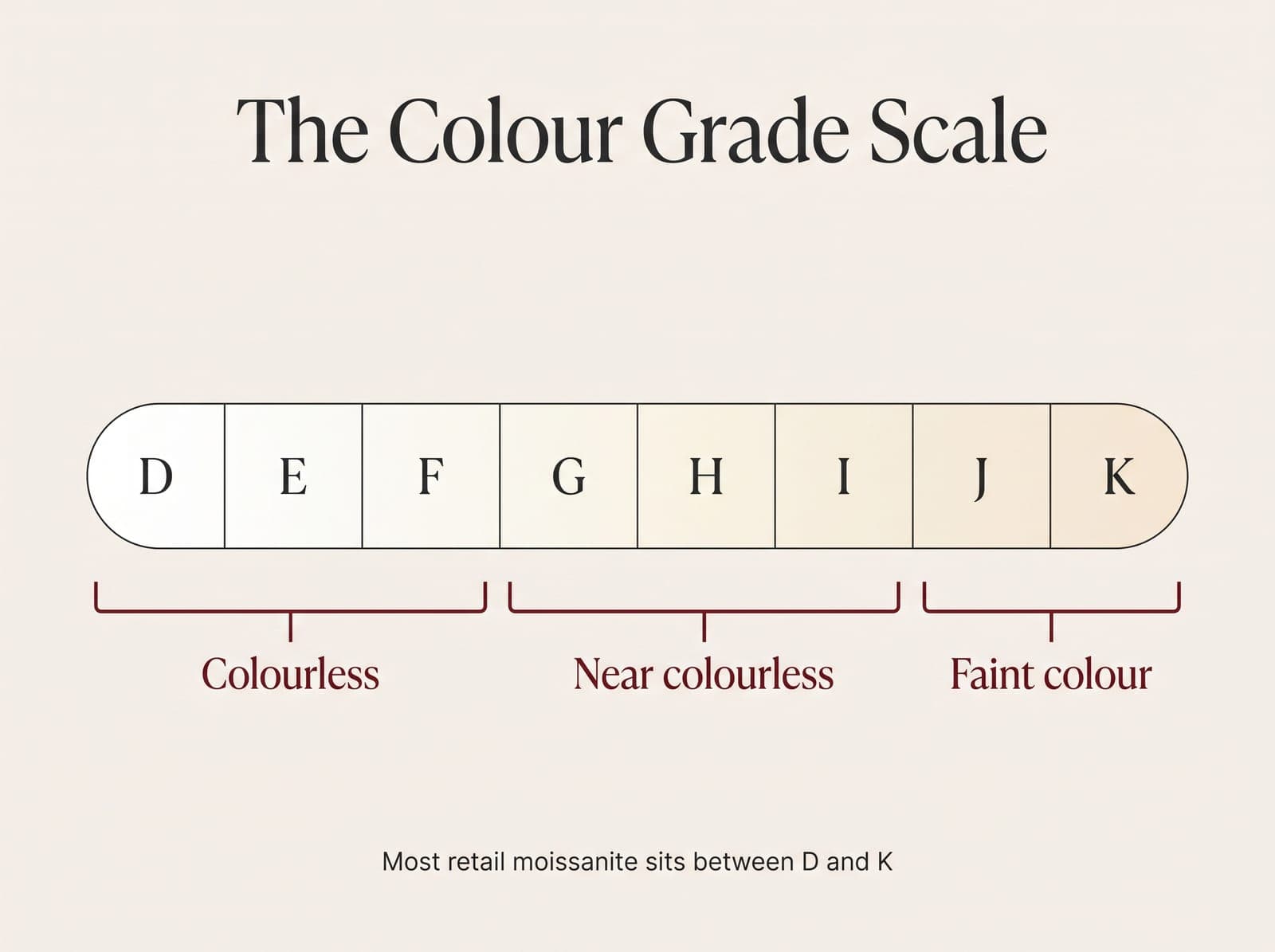
Moissanite uses the same colour scale as diamonds, set by the Gemological Institute of America (GIA). The scale runs from D (completely colourless) all the way to Z (light yellow or brown). You'll rarely see anything beyond K in retail moissanite, and here's why.
D-F grades: the colourless tier
D, E, and F are officially "colourless" under the GIA scale. In moissanite, this means the stone has zero detectable colour tint, even under magnification. D is the pinnacle, E and F are so close that telling them apart is academic.
What does this actually look like? A D-colour moissanite catches every ray of light in your room and throws it back as pure, prismatic fire. Under daylight, under office fluorescents, under the yellow glow of a restaurant candle, it looks the same: bright, clear, and alive. This is the gold standard for moissanite jewellery in New Zealand and Australia. Miozuki stocks D-colour moissanite only.
G-I grades: near colourless, virtually invisible to the eye
G, H, I, and J are classified as "near colourless." Technically, under 10x magnification by a trained eye, these stones show a faint colour tint. In real life, wearing them on your hand? It vanishes.
Here's what matters: moissanite's natural fire (that rainbow sparkle) is so bright that it actually masks any faint colour tint. You will not see the difference between a D and a G-colour moissanite unless you're comparing them side by side under direct, magnified inspection. In daily light, they're identical to the eye.
For New Zealand and Australian customers shopping the wider market, G-I grades are the practical choice for everyday moissanite. You get the same visual clarity as D-colour, the same durability, and you save 10-15% on price. At Miozuki, all grades are the same price, since pricing is determined by style, design, and carat size rather than grade.
J-K grades and beyond: where colour starts to show
J-K grades sit at the boundary where faint colour becomes detectable without magnification. In a J-colour moissanite, you'll see a subtle warmth, like looking through a very pale champagne tint. In K-colour, that warmth becomes visible in any light.
This matters most for larger stones (2 carat and above), because the bigger the table (the top facet), the more visible any colour tint becomes. A 0.5-carat J-colour moissanite will still look completely clear. A 3-carat J-colour moissanite will show a noticeable warmth, especially beside a D or E.
For Australian and New Zealand customers looking for statement pieces, J-K grades can be intentional choices. Some wearers prefer that slightly warmer glow, and it's a legitimate aesthetic preference, not a compromise. But if you want true colourlessness, stop at I.
Understanding clarity grades: how to know what you're actually seeing
Clarity measures inclusions (internal) and blemishes (surface) on and inside the stone. Like colour, moissanite uses the GIA scale. Unlike colour, the clarity scale actually translates to visible differences once you know what to look for.
VVS1 and VVS2: "very very slightly included"
VVS (very very slightly included) means the stone has minute inclusions visible only under 10x magnification, and even then, you need good lighting and a trained eye to spot them. For practical purposes, VVS is flawless.
If you're buying a moissanite ring or earrings for daily wear in New Zealand, VVS is where most fine moissanite lives. It's eye-clean in all lighting conditions. No haziness, no internal fractures, no visible inclusions whatsoever. And it ages well: a VVS stone at 20 years old still looks exactly as clear as it did on day one. Miozuki carries VVS1 to VVS2.
VS1 and VS2: "very slightly included"
VS grades have minor inclusions visible under magnification but not to the naked eye under normal lighting. These are still excellent stones for daily wear. The inclusion is usually so small and positioned so inconspicuously that you'll forget it exists.
VS moissanite is the practical middle ground. You're getting genuine eye-clean clarity at a lower price point than VVS. Unless you spend hours examining your ring under a jeweller's loupe, you won't know the difference.
SI1 and SI2: "slightly included"
SI grades have inclusions that may be visible to the naked eye, depending on the inclusion's size, location, and type. This is where clarity becomes a real consideration for your choice. Some SI1 stones are absolutely eye-clean; others have a faint haziness or a small cloud that's visible in the right light.
SI moissanite is not a bad choice, especially for fashion rings or occasional-wear pieces. But for an engagement ring or a daily-wear earring, it's the point where you should start asking questions. Is the inclusion visible in normal lighting? Where is it positioned? Does it catch light in a way that draws your eye?
Moissanite brands and quality tiers: Forever One, Harro, NEO, and others
When you shop for moissanite, you'll see brands and tiers that sound like they matter more than they do. The main ones are Forever One (Charles & Colvard's top grade), Harro (Charles & Colvard's mid-tier), and NEO (a newer, budget-friendly tier). Here's what you're actually comparing.
| Brand / tier | Colour | Clarity | What's different | Who makes it | Best for | Price point |
|---|---|---|---|---|---|---|
| Forever One (Brilliant) | D | VVS1 to VVS2 | Lab-created moissanite with strict grading; superior cut precision and quality control. This is Charles & Colvard's flagship. The stone sits at the absolute top of the market | Charles & Colvard (the original moissanite company, since 1995) | Engagement rings, pieces you'll wear daily, anyone who prioritises absolute top-tier consistency | Premium; highest cost per carat |
| Harro (or "H Colour" variants from major retailers) | G-I typically, though some offer D | VS1 to VVS1 | Same lab-creation process but slightly relaxed grading standards. Colour and clarity are still excellent, just not the "absolute pinnacle" positioning. Excellent durability and fire | Multiple manufacturers; Harro is Charles & Colvard's mid-tier, but other brands and independent labs also offer this tier | Everyday moissanite, earrings, pieces where you want quality without paying for the top-tier name | Mid-range; 15-25% less than Forever One |
| NEO (newer, budget-conscious tier) | H to J, rarely D | SI1 to VS2 | The same durability as all moissanite (Mohs 9.25), but with broader colour and clarity tolerances. These stones are genuinely eye-clean but less precisely graded. | Multiple manufacturers, including newer Chinese moissanite labs alongside established names | Fashion rings, statement pieces where size and budget matter more than absolute clarity and colourlessness, younger buyers building a collection | Budget-friendly; 30-40% less than Forever One |
| Independent lab moissanite (unlabelled or regional brands) | Varies; often G-I | Varies; often VS1 to VVS | Less marketing overhead means lower cost. Quality depends heavily on the specific lab and stone, so buy from a jeweller you trust | Various labs globally, including increasingly sophisticated operations in China, India, and Russia | Anyone who prioritises local purchase and personal relationship with the retailer over brand prestige | Wide range; can be the cheapest option if bought from a no-frills online retailer |
Why brands matter less than you might think
Here's the truth that moissanite retailers often gloss over: all moissanite is lab-created silicon carbide. It is chemically and optically identical. A Forever One D-colour VVS1 and a no-name-brand D-colour VVS1 are the same stone, optically speaking.
The difference is in consistency and positioning. Forever One, as Charles & Colvard's flagship, has decades of brand reputation and strict quality control. You know exactly what you're getting. Harro is their mid-tier, still backed by the same company and grading. NEO and independent brands are usually just as durable, but the grading standards are broader and the supply chain is less controlled.
Miozuki does not stock named brand tiers or multiple quality grades. These branded lines remain market context only.
For a New Zealand or Australian buyer, this means: if you're buying from a local jeweller in Auckland or Sydney who personally sources their moissanite and stands behind it with a warranty, you can trust a slightly cheaper, lesser-known tier. If you're buying from an international online retailer you've never dealt with, Forever One or Harro gives you insurance that you're getting what the grading certificate says.
The grades that actually matter versus the ones that don't
Let's be direct about the gaps between theory and practice.
Colour differences of 1-2 grades (D to E, E to F, G to H): You will not see these without magnification. Save your money. Move up to the next tier in clarity or carat weight instead.
Colour differences of 3+ grades (D to G, G to J): You can see D versus J if you're looking for it, especially in larger stones. But under normal wearing conditions, the difference is modest and highly personal. Some wearers prefer the warmth of a G or H. Others feel committed to D.
Clarity differences of 1-2 grades (VVS1 to VS1): Not visible. Spend the savings elsewhere.
Clarity differences of 3+ grades (VVS to SI): This is where you might spot a difference, especially under bright light or magnification. For daily wear, most SI1 stones are still perfectly eye-clean. SI2 is riskier.
Brand tier differences (Forever One to Harro): The visual difference is minimal. The insurance of brand consistency is real. If budget is tight, Harro is almost always the better choice than Forever One.
Brand tier differences (Harro to NEO or independent brands): Again, minimal to your eye. The supply-chain confidence matters more than the label.
The upgrade that matters most: carat weight and cut. A beautifully cut 1.5-carat G-colour VS1 moissanite will catch more light and feel more generous on the hand than a precisely cut 1.0-carat D-colour VVS1, and it'll cost less. That's where your money creates real, visible change.
Colour and clarity: what the paper says versus what your eye sees
Moissanite certificates come with a formal grade, just like diamonds. But here's the thing: moissanite is so durable and so bright that the gap between grades feels smaller than it looks on paper.
A moissanite with a slight colour tint in a D-I range shows almost zero warmth in daylight because its natural fire is so intense. A moissanite with a minor inclusion in a VS range shows up eye-clean in all normal lighting because moissanite's refractive index bounces light away from internal blemishes at a different angle than diamonds do.
This is why colour and clarity matter for moissanite, but not obsessively. You're not compromising quality if you choose G over D, or VS1 over VVS1. You're making an intelligent choice about where your money creates the most visible difference to your life.
For New Zealand buyers especially, this matters. Our coastal light and the long summer days mean bright, natural light most of the year. Moissanite's fire sparkles gorgeously in that light no matter whether it's D or G colour. Pick the grade, not the grade name.
Grading certificates and lab reports: what to trust
When you buy moissanite, you should receive a grading certificate from a recognised lab. The main ones are the GIA (Gemological Institute of America), the GCAL (Gem Certification & Assurance Lab), and various independent labs.
A certificate tells you the colour, clarity, cut, and carat weight. It's not a guarantee that the stone will last forever (moissanite will; the setting might not), and it's not a price guide (two D-VVS1 stones from different labs can vary in price by 20-30% depending on cut quality and retailer margins).
What it is: a reliable third-party assessment of what you're buying. If you're ordering online and can't see the stone in person, a certificate from GCAL or GIA gives you confidence. If you're buying in person from a local jeweller in New Zealand or Australia, a certificate is useful for insurance and for future resale, but your eye and the jeweller's reputation matter more. Miozuki does not use or require grading lab certification; the lab-grading discussion above is market context only.
Common questions
What colour and clarity grade should I choose for an engagement ring?
At Miozuki, the standard for engagement rings is D colour and VVS1 to VVS2 clarity, with one price per design regardless of grade, since pricing is determined by style, design, and carat rather than grade. For the wider market, D colour and VVS1 to VVS2 clarity is the traditional choice and the easiest to defend later. G-I colour and VS1 clarity is smarter money if you're shopping beyond Miozuki: you save 15-20% and gain zero visible difference in daily wear. SI1 and below start showing faint haziness under some lights; skip them for engagement rings unless you're a deliberate risk-taker or the stone is very small.
Is Forever One really better than other moissanite brands?
Forever One is more consistent and has more rigorous grading. It's not scientifically "better" (all moissanite is identically durable and optically similar), but the brand insurance is real. If you're spending NZ$2,000 or more and buying online from a retailer you haven't worked with before, Forever One or Harro reduces your risk. For smaller pieces or local purchase, the brand matters far less.
Can I see the difference between D and G colour moissanite in sunlight?
No, not unless you compare them side by side. Moissanite's fire is so bright that it hides colour tints beautifully. In New Zealand's coastal light especially, a G-colour moissanite will sparkle identically to a D under daylight. Save the upgrade money for carat weight or a better setting.
Does moissanite clarity degrade over time, or does yellowing happen?
No. Moissanite doesn't yellow or cloud or lose clarity over time with normal wear, regardless of clarity grade. A VVS1 stone stays visually identical at year one and year twenty, and the same is true for any Miozuki moissanite. The stone itself is permanent. The metal setting can scratch or wear, and a dirty setting can make the stone look duller (easily fixed with cleaning), but the moissanite itself never changes.
Should I choose a larger carat weight in a lower clarity grade, or a smaller carat weight in a higher grade?
Larger and lower clarity almost always wins visually and practically. A 1.5-carat SI1 moissanite will look more generous and will still be eye-clean in all normal wear. It catches more light, sits bolder on your hand, and costs less than a 1.0-carat VVS1. The only reason to choose smaller and higher is if clarity obsesses you or you're buying an heirloom piece you want to be flawless on paper.
When colour and clarity genuinely matter
There are moments when upgrading the grade makes a real difference.
You're buying a solitaire ring or solitaire studs, and the stone is the entire visual statement. In that case, D colour and VVS clarity create a noticeable confidence that you're wearing the absolute best. You'll never second-guess the choice.
You're buying a 2-carat or larger stone, and you want zero warmth or visible inclusions. At that scale, even G-colour starts to show warmth in some lights, and SI1 clarity can show haziness. Moving to D-VVS is worth the upgrade cost for those sizes.
You're buying an heirloom piece intended to be passed down. A D-VVS1 certified moissanite is unambiguously top-tier and will be just as beautiful fifty years from now. The certificate matters for your children and their children.
You're buying from an online retailer you've never worked with. A Forever One or Harro certification reduces your risk and makes returns easier.
For everyone else: G-I colour and VS1 clarity is the sweet spot. You're buying moissanite's full durability and beauty without paying for bragging rights. That's actually the smarter choice.
NZ and Australian pricing
Moissanite prices in New Zealand and Australia are typically quoted in NZD for local customers and AUD for Australian shoppers, with the same stone available on either side of the Tasman. Exchange rates affect the final cost, but pricing approaches vary widely.
In the wider NZ market, gold-set moissanite pieces run roughly NZ$1,500 to NZ$4,000 for 2ct+ engagement rings, with smaller pieces (earrings, 0.5 to 1-carat studs and rings) ranging from NZ$300 to NZ$800 for good-quality mid-tier grades, and NZ$2,000 to NZ$6,000+ for branded top-tier stones like Forever One.
At Miozuki, pricing is simpler: one grade standard (D colour, VVS1-VVS2), studs from NZ$255, rings from NZ$320 to NZ$795, priced by design and carat rather than grade.
Australian customers should note that Miozuki ships to Australia, and AUD conversion rates mean a NZ$2,000 piece is roughly AUD $1,960 at current rates, though duty may apply to orders over AUD $1,000 depending on your state. Check Australian customs rules before ordering.
One more thing: the moissanite myth you can stop worrying about
You'll read that moissanite "clouds" with wear or develops a haze over time. This is false. The myth probably started because some early moissanite (pre-2000) from experimental lab runs had lower clarity. Modern moissanite does not cloud. It does not yellow. It does not change appearance with normal wear.
What does happen: if your ring sits in a jewellery box for months without cleaning, dust and skin oils build up on the facets, and the stone looks duller. Clean it with a soft cloth and mild soap, and the fire returns instantly. That's not degradation, that's just dirt.
How to choose: your personal decision map
You now know the grades. Here's how to actually choose.
Ask yourself: how will I wear this? Daily wear needs VVS or VS1 clarity; occasional wear can stretch to SI1. Outdoor, coastal wear (common in New Zealand and Australia) benefits from D colour because sunlight shows warmer tints more clearly, but G colour still looks identical under daylight.
Ask yourself: what's my budget? Work backwards from price, not grade. If you have NZ$2,000, decide whether you want a 1-carat D-colour solitaire ring or a 1.5-carat G-colour with a better setting. Both are beautiful. The second one catches more light.
Ask yourself: am I buying from a jeweller I trust? If yes, a mid-tier grade (G-I, VS1) from a local retailer you know is a better choice than chasing a Forever One from an unknown online store. If no, Forever One or Harro reduces your risk.
Ask yourself: is this an investment piece or a love piece? If it's "I'm passing this to my daughter," go D-VVS with a certificate. If it's "I love moissanite and I want to enjoy it," save the money and buy size.
That's grading, distilled. The rest is joy.
References and further reading
For more detail on how moissanite stands up to daily wear, see our moissanite durability guide.
If you're comparing moissanite to other options, read moissanite versus lab diamond and moissanite versus diamond.
For guidance on which moissanite ring is right for you, see how to choose a moissanite ring.
This guide is written in first person as Ting, the founder and designer at Miozuki. I craft every piece with New Zealand and Australian life in mind, and every moissanite choice should reflect what actually matters to you, not what grades sound impressive.
Citation
The GIA (Gemological Institute of America) colour scale, which moissanite grading systems use, is the international standard for gemstone colour grading.