
Moissanite vs Diamond NZ: An honest comparison
The short answer: moissanite is a real gemstone, lab-grown and ethical, with more sparkle than a diamond and a fraction of the cost. It holds up perfectly to daily wear, lasts a lifetime, and catches the light in a way that's distinctly its own. If you care about what you're buying, not just the name attached to it, moissanite deserves serious consideration. I chose moissanite for Miozuki because I believe it is the more thoughtful choice for most people.
My quick recommendation
Choose moissanite if you want a bright, lively sparkle, a more generous stone size, and a lab-grown gem that feels thoughtful to wear every day.
Choose diamond if you love its tradition, prefer a softer white sparkle, or want a stone with stronger resale value.
For many Miozuki customers in New Zealand, moissanite feels right because it lets them choose a beautiful, lasting piece without putting all of their budget into the stone.
At a glance
| Aspect | Moissanite | Diamond |
|---|---|---|
| Cost | Market NZD 1,500–3,000, typically set in gold | NZD 5,000–40,000 for a 1-carat mined stone (by quality) |
| Hardness | 9.25 on the Mohs scale; excellent daily wear | 10 on the Mohs scale; marginally harder, rarely matters in practice |
| Appearance | Brilliant sparkle and fire, distinct look, beautiful in its own right | A different kind of brilliance, more understated, traditional |
| Ethics | Lab-grown, no mining, conflict-free by design | Mined, environmental and social variables depending on source |
| Longevity | 100+ years with minimal care | 100+ years with minimal care |
A lot of our customers who choose a moissanite ring want a bigger carat size and a more dramatic sparkle, because the same size diamond would cost a lot more. Visually, though, they can look very similar.
A question I often get asked by customers is: can you actually tell the difference between moissanite and a diamond just by looking at them?
My honest answer is, not always. If you're not trained or used to looking at gemstones, they can appear very similar at first glance.
The difference becomes more noticeable under bright lighting or in sunlight. Moissanite tends to give off more colourful, rainbow-like flashes, while both natural and lab-grown diamonds usually have a softer, whiter sparkle.
My personal advice is to think about which type of sparkle you're naturally drawn to. If you love something bright, dramatic and full of rainbow flashes, moissanite could be perfect for you. If you prefer a more subtle, classic white sparkle, I'd recommend a diamond.
If you are ready to compare real ring styles, start with Miozuki's moissanite rings in NZ. If you are still deciding how you feel about the stone itself, keep reading first.

Why this comparison matters
When I started Miozuki, I did not choose moissanite simply because it was a more affordable option. I chose it because I wanted to offer beautiful, meaningful jewellery that could be worn and enjoyed every day, without asking people to compromise on sparkle and quality. A diamond at NZD 10,000 carries weight beyond the stone itself. That's not a judgement on people who choose diamonds; it's simply a fact about the financial reality in New Zealand.
Premium moissanite in the wider NZ market ranges from NZD 1,500 to 3,000, typically set in gold (NZ Jewellers). At Miozuki, a 1ct classic solitaire moissanite ring currently starts from NZ$300 in S925 sterling silver, with 9k gold options priced higher depending on the selected metal. At Miozuki's price point, you choose the metal, the setting, and the feeling you want on your hand without spending significant money. It lets a couple redirect those savings toward the life they're building together: a deposit on a home, a meaningful honeymoon, freedom to take time off work in the early months of marriage, or simply peace of mind knowing they're not carrying debt into their new partnership.
That said, the comparison is fair. Both are real gemstones. Both last forever. Both are genuinely beautiful. The choice isn't about one being objectively better. It's about what matters to you. And I think that question deserves an honest answer, not marketing spin.
This guide walks through nine honest points of comparison. I'm not here to convince you that moissanite is right for everyone. It's not. But it may be right for more people than they first realise.
Cost: the immediate difference
Here's where the gap is most visible. Premium moissanite in the NZ market costs NZD 1,500–3,000 for a 1-carat equivalent, typically set in gold (NZ Jewellers, fourwords.co.nz). A 1-carat mined diamond in New Zealand starts around NZD 5,000 for lower grades and climbs to NZD 40,000 or beyond for stones with excellent colour and clarity (Diamonds on Richmond).
For a full ring in the wider market, moissanite solitaires range from NZD 2,000–4,500, typically set in gold, while a comparable diamond solitaire runs NZD 8,000–20,000, sometimes significantly more if you want a larger stone or higher grade.
At Miozuki, our 1ct classic solitaire currently starts from NZ$300 in S925 sterling silver, with 9k gold options priced live on the product page.
That difference isn't academic. It's meaningful money. It's the money you could spend on an incredible honeymoon, a mortgage deposit, a holiday with extended family, or simply keeping in your pocket for the unexpected things life throws at you. I think financial sense can be its own quiet kind of grace.
What you don't get back, though, is anything like a linear return on the money. A diamond that costs twice as much isn't twice as beautiful. It's just a different stone, often with a different story attached to it. Many of us have inherited the idea that more expensive means more precious. It's worth gently questioning.
There's also the psychology of cost. A ring should make you feel joy when you look at it, not financial regret. I've met people who chose smaller diamonds because that's what they could afford, people who stretch themselves financially for the "right" stone. I've met others who chose moissanite and never once questioned it, because the money stayed in their life instead of disappearing into a gemstone. Both groups can have beautiful rings. The difference is how much financial shadow the purchase leaves behind.
Buying from Australia? We ship there too, and prices show in Australian dollars at checkout. One thing worth knowing upfront: Australian orders totalling over about AUD $1,000 can attract GST and duty at delivery, charged on the order total rather than any single piece. Most moissanite rings sit comfortably under that line, which is one more quiet advantage of not paying for a mined stone.
Where the saved budget can go: the metal and setting
The quieter advantage of moissanite is not only that the stone costs less. It gives you more room to choose the whole ring well.
With a diamond, a large part of the budget often goes into the centre stone before you have even chosen the band. With moissanite, more of that budget can go toward the metal, the setting height, the prong work, and the feeling of the ring on your hand. That is where a gold moissanite engagement ring can make sense: you can choose a bright, durable stone and still consider 9k gold as the setting, rather than treating gold as out of reach.
At Miozuki, most moissanite ring styles now offer S925 sterling silver and selectable 9k gold options in white, yellow, and rose gold. In New Zealand, you may also see 9k gold written as 9ct gold. If you are comparing metal options, browse Miozuki's white, yellow and rose gold moissanite rings, then use our moissanite ring choosing guide if you want help deciding which metal suits your daily wear.

Appearance and sparkle: they're genuinely different
This one tends to divide people, and honestly, it should. Moissanite and diamond do not look identical.
Moissanite throws more light. It has higher refractive index, which is the optical term for how much a stone bends light and sends it back at you. This results in more sparkle (more visible flashes of colour, more brilliance). In bright daylight, particularly direct sunlight, moissanite can show rainbow fire. A diamond's sparkle is subtler, more of a white flash. Some people call it a "glass-like" sparkle for diamond, and the description is apt.
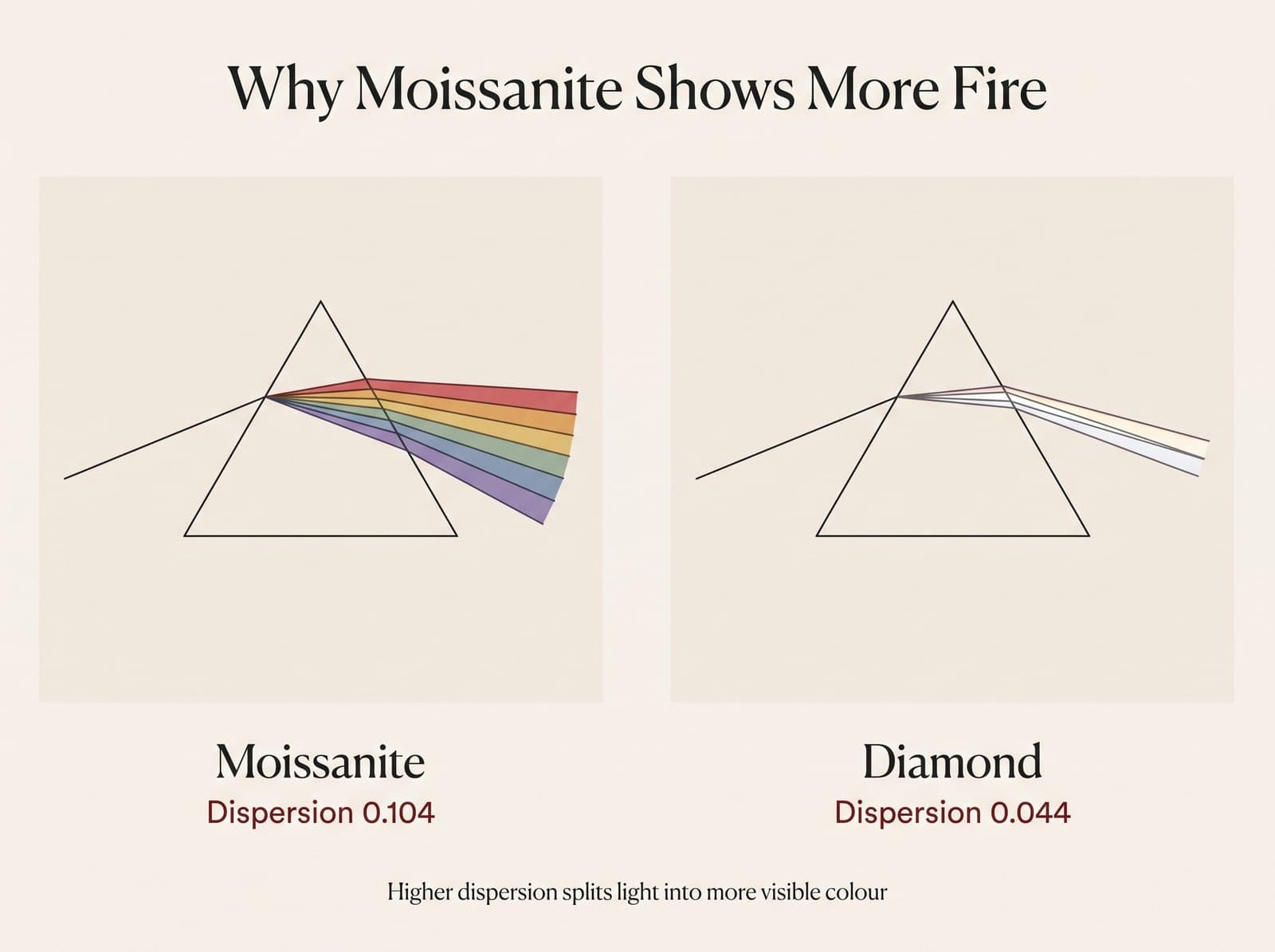
Is one better? That depends entirely on what draws your eye. I find moissanite's sparkle joyful and alive. It catches the light and turns it into a little celebration on your finger. Others prefer diamond's quieter elegance, the understated brilliance that doesn't announce itself. Neither is wrong. They're just two different conversations that light has with a stone.
One thing worth noting: if you spend time looking at moissanite under very specific lighting (direct sunlight, certain types of indoor lights like fluorescent or LED), you might see a faint rainbow pattern in the stone's facets. This is the "rainbow effect" some people talk about. In most real-life settings, in your home or at your desk, in normal daylight through a window, you won't see it. If it bothers you, that's useful information about your own taste. If you love it, you're not alone. Many people choose moissanite precisely for that quality.
The sparkle difference becomes less noticeable in indoor office lighting, in evening settings, and under warm household lights. It becomes most apparent outdoors in direct sunlight or at weddings with lots of bright flash photography. If you spend most of your time in an office or indoors, the difference might be quite subtle. If you're outdoors frequently, you'll notice it.
The bottom line is this: moissanite looks like moissanite. Diamond looks like diamond. They're both beautiful. The choice is whether you want the subtle traditional look, or the brilliant sparkle that's entirely its own. And that's a genuinely personal choice that only you can make.
Durability: both will last forever
On the Mohs hardness scale, moissanite sits at 9.25 and diamond sits at 10, a difference that sounds meaningful on paper but proves negligible in real life. Both stones are sufficiently hard for everyday wear, surviving swimming, gardening, hiking, and all the ways you actually live in your ring. For the full story on durability, everyday wear, and the clouding myth, read our guide on moissanite durability.
Colour and clarity: the technical grades
Both stones come in colour and clarity grades, but moissanite's lower grades typically appear eye-clean (no visible inclusions to the naked eye), while a lower-grade diamond might show visible characteristics, making moissanite better value per grade. For the detailed breakdown of grades, brands, colour differences, and how to choose the right grade for you, see our moissanite grades and brands guide.

Ethics and origin: the bigger picture
Every moissanite stone is lab-grown in a controlled facility, creating an ethical gemstone by design with no mining, environmental disruption, or supply-chain uncertainty. Diamonds, by contrast, are mined through an extractive process with real variables around environmental impact and labour practices. The market is shifting: lab-grown diamonds now account for more than 45% of US engagement ring purchases, according to BriteCo's analysis of hundreds of thousands of insurance and appraisal transactions. That's not just niche interest. That's the mainstream. For a full exploration of the ethics story and what lab-grown really means, read our guide on ethical engagement rings.
Resale and the meaning question
This is where I'm blunt: moissanite has lower resale value than diamond. If you ever needed to sell your stone, you'd get back significantly less than you paid. That's a real disadvantage if you're thinking of your ring partly as an asset or insurance.
But here's my question in return: are you buying it to sell?
Moissanite is made to be kept and worn. Someone who holds your moissanite ring 30 years from now will not love it because of a resale figure. They will love it because it's yours, and because it's a genuinely beautiful stone they can wear without hesitation or compromise.
I think about rings differently than most of the industry does. A ring isn't a financial asset. It's a story you wear on your hand. It's the commitment you made, the person you promised to build a life with. That story becomes more precious over time, not less. The stone doesn't need to have resale value for the ring itself to have infinite value to the people who love it.
Diamond's higher resale value is real, and it matters if you're thinking of it partly as an investment or insurance against future need. But if you're thinking of it as something meaningful to wear, something that becomes more precious over time because of what it represents, then resale value becomes less important than durability, beauty, and the story you want to tell.
The rings I choose for Miozuki are chosen to be kept and worn with feeling. Their value is not only in what they might be worth later, but in the life they become part of.
Availability and what you can actually get
In New Zealand and Australia, finding moissanite is straightforward. Finding a great diamond can be more complex and more expensive, because both markets import most of their stones, and the range at any single retailer is limited unless they have direct supply relationships.
With moissanite, because the cost per stone is lower and the demand is growing (63% of Gen Z in the US are likely to consider moissanite, according to Helzberg Diamonds' 2025 Engagement & Ring Shopping Survey), there's more variety in cuts, colours, and sizes available. You have real choice in what you're buying, not just a choice between a handful of pre-selected stones that someone else decided to stock.
This matters for something simple: you get to design the ring you actually want, not the ring that's available at the price you can afford. The design freedom that comes with moissanite is real. You're not compromising on what the ring looks like because you're trying to hit a particular price point. You're getting the design you actually want, at a price that makes sense for your life.
That's a different experience than diamond shopping often is. With diamond, you might fall in love with a design, only to find that adding a larger or higher-grade stone pushes it far beyond your budget. With moissanite, the cost is separated from the design choices, so you can have both.

Care and maintenance
Both moissanite and diamond require basic care. Warm soapy water and a soft cloth cleans both beautifully. Both can handle daily wear. Both last indefinitely with ordinary maintenance.
Neither stone needs special treatment. Neither requires protective case storage. Neither will degrade over time if you wear it in the shower, at the gym, or in the garden. You can live in your ring. That's the whole point. You don't need to take it off for your life; you can wear it through your life.
The only real maintenance either stone needs is occasional cleaning to keep it looking brilliant. A gentle scrub with warm soapy water once a month keeps either stone looking new. That's all. No special cleaners needed. No professional polishing required. Your ring is a piece of jewellery to wear and love, not an artefact to preserve behind glass.
The longevity story: what "forever" actually means
When people say a diamond is "forever", they're drawing on an idea that marriage itself is forever, and therefore the stone should be too. It's a powerful line, because it ties the permanence of the stone to the permanence of the relationship. And it's also true: a diamond, like moissanite, will outlast you and everyone you know.
Moissanite's permanence is identical. It will not degrade, cloud, or become less beautiful over 50 or 100 years of wear. It will look in 50 years exactly as it does today. If anything, it can become more meaningful with time, as the physical embodiment of a promise that was kept.
What's different is the emotional weight. A diamond comes with a strong cultural story of timelessness. Moissanite comes with the freedom to write your own narrative: your own reasons for choosing it, your own understanding of what you're wearing, your own story.
Both last forever. One comes with a story built in. The other comes with the freedom to build your own. I prefer the second option. I think most people do, once they're given the choice.
Comparison table: moissanite vs diamond, point by point
| Factor | Moissanite | Diamond | Verdict |
|---|---|---|---|
| Cost per carat | Market NZD 1,500–3,000, gold-set | NZD 5,000–40,000 by quality | Moissanite significantly less expensive (NZ Jewellers) |
| Mohs hardness | 9.25 | 10 | Both are suitable for daily wear; difference is negligible in real life |
| Sparkle style | Brilliant, visible rainbow fire in bright light | Subtle white flash, quieter brilliance | Personal preference; both are beautiful |
| Eye clarity | Most grades appear eye-clean | Lower grades may show visible inclusions | Moissanite typically offers better value per grade |
| Environmental impact | Lab-grown, no mining | Mined; environmental variables | Moissanite is more straightforward ethically |
| Longevity | 100+ years, no degradation | 100+ years, no degradation | Identical |
| Resale value | Lower; not designed for resale | Higher; holds financial value | Matters only if you plan to sell |
| Availability in NZ | Readily available in various grades | Limited selection; most imported | Moissanite offers more choice locally |
| Colour grading | D–K scale, visually similar across grades | D–Z scale, visible differences in lower grades | Both are graded; moissanite consistency is simpler |
At Miozuki, a 1ct classic solitaire currently starts from NZ$300 in S925 sterling silver.
How to decide: a framework
Here are the questions I'd ask if you were sitting across from me at my studio, trying to figure out which stone is right for you.
First: what have you heard about moissanite, and is it actually true? Some people still think it is fake, cheap, cloudy, or inherently lesser. None of that is true. Moissanite is a real gemstone with its own genuine beauty, and it deserves to be judged on what it is. If the worry is whether moissanite is like cubic zirconia, the short answer is no: moissanite is different from cubic zirconia in material, hardness, sparkle, and daily-wear longevity.
Second: what matters most to you? If it's the environmental story, moissanite wins. If it's the financial freedom to spend money on your actual life, moissanite wins. If it's the sparkle, you need to see both in person and decide. If it's the traditional narrative, diamond might feel right. There's no wrong answer here.
Third: what's your real budget? Not the budget the industry tells you that you should have. Your actual budget. If you've got NZD 15,000 to spend and diamond is important to you, buy diamond. If you've got NZD 4,000 and you want a beautiful ring, moissanite lets you get a striking piece with money left over. Spend what makes sense for your life.
Fourth: where will you wear it? If you're in an office under fluorescent lights most of the time, the sparkle difference between the stones is almost invisible. If you spend time outdoors or in bright natural light, you'll notice moissanite's extra sparkle more.
Fifth: do you care what other people think? Some people do. If people knowing it's moissanite would bother you, that's real and worth considering. Most people won't know, and most people who do know will respect the choice. But only you know how much that matters to you.
The right choice is the one that makes sense for your values and your life. Not your mother's values. Not your partner's expectations. Yours.
Why I choose moissanite
Every ring I choose for Miozuki starts with a question: what does this person actually need? Not what does the industry tell them they should want. Not what comes with the biggest marketing budget behind it.
Moissanite lets me choose real pieces for real people. It leaves more room for better metals, better settings, and more thoughtful proportions, because the stone cost doesn't consume the whole budget. It lets someone say yes to a beautiful ring without financial regret. It lets an engagement become the joyful thing it should be, rather than a financial milestone or a debt you're carrying into your marriage.
When I choose pieces for Miozuki, I think about how they will feel in real life: on the hand, in daily routines, and in the moments people remember. Moissanite is the stone that matches that way of choosing.
You might choose diamond. That's a completely legitimate choice, and if you do, I'd rather you choose it with open eyes, understanding what you're getting and why, rather than because you felt you had to. But if you're here reading this, if you're asking the question about moissanite versus diamond, then I think you deserve an honest answer.
Here it is: moissanite is real. It's beautiful. It's ethical. It lasts forever. And it gives you room to build the rest of your life without putting all of your budget into one stone.
That, to me, is the real choice.
Common questions
Does moissanite look fake?
No. Moissanite is a real, lab-grown gemstone with its own genuine sparkle, not an imitation diamond or synthetic. If "fake" means it's not mined from the earth, then yes, it's lab-created, just like lab-grown diamonds are. But fake implies it's not a real stone, and that's not accurate. Moissanite is a real gemstone that happens to be created in a lab rather than formed in the earth's crust, and it's been used in fine jewellery for over 25 years. Its optical and physical properties are well-documented and consistent. It's just as real as diamond; the origin is different, not the realness.
Is moissanite a diamond?
No. Moissanite is not a diamond. It is a real gemstone made from silicon carbide, while diamond is made from carbon. The two can look similar in a ring, especially at a glance, but they are different stones with different sparkle, price, sourcing and resale value. I think that difference is part of the point: moissanite does not need to pretend to be diamond to be beautiful.
Will moissanite cloud over time?
No. This is a persistent myth, but there's no scientific basis for it. Moissanite does not cloud, fog, or become less clear over time. The claim originated from older moissanite from the 1990s, and modern moissanite is dramatically improved. Moissanite has been trending in New Zealand since around 2021, and the stones I see hold their brilliance with simple care. Like any gemstone, moissanite needs occasional cleaning with soap and water, but the stone itself doesn't degrade. The cloudiness myth has been thoroughly debunked by independent testing, and it simply doesn't happen with modern moissanite.
Can people tell the difference between moissanite and diamond?
Without specialized equipment, most people can't tell the difference just by looking at a ring on your hand in normal circumstances. The difference is most visible in bright sunlight, where moissanite's extra sparkle becomes apparent. In normal indoor light or office settings, the stones are much harder to distinguish at a glance. The real answer, though, is: does it matter? Most people don't examine your ring under a magnifying glass or bright sunlight; they see it on your hand in everyday life, and what they see is beautiful jewellery. If someone asks what stone it is and you tell them, the right response is to tell them the truth and let them decide if it changes their opinion.
Should I choose diamond if I want something traditional?
Not necessarily. Moissanite's modern history goes back over 25 years in jewellery, and plenty of people choose it precisely because they like its appearance and value proposition. If you prefer a quieter, more understated sparkle, that's a completely valid aesthetic preference, and there are beautiful diamonds out there. But tradition does not have to mean only one stone. Moissanite is a legitimate choice, and it's increasingly chosen by people who care about beauty, ethics, and financial sense in equal measure. The most meaningful thing you can do is choose something beautiful that you love, and that's possible with either stone.
Is moissanite a good choice for a gold engagement ring?
Yes. Moissanite is durable enough for daily wear, and setting it in 9k gold gives the ring a stronger long-term metal choice. It can be a thoughtful option if you want a gold engagement-style ring without putting most of the budget into a mined diamond.
What's the best choice for an engagement ring?
The best choice is the one that makes sense for your life and your values. If you're buying an engagement ring, ask yourself these questions: Do I want to minimise cost so I can redirect that money toward our actual life together? Do I care about the environmental and ethical story behind my stone? Do I prefer the sparkle of moissanite or the subtlety of diamond? Am I buying this partly as an investment, or purely as something to wear and love? Would I feel secure and happy with this choice five years from now? Answers to those questions point you toward the right stone, not any external standard or industry narrative.